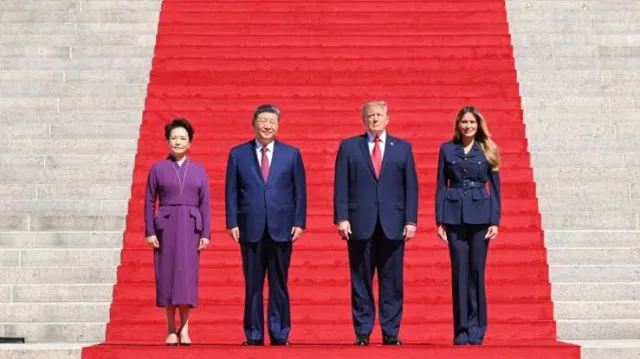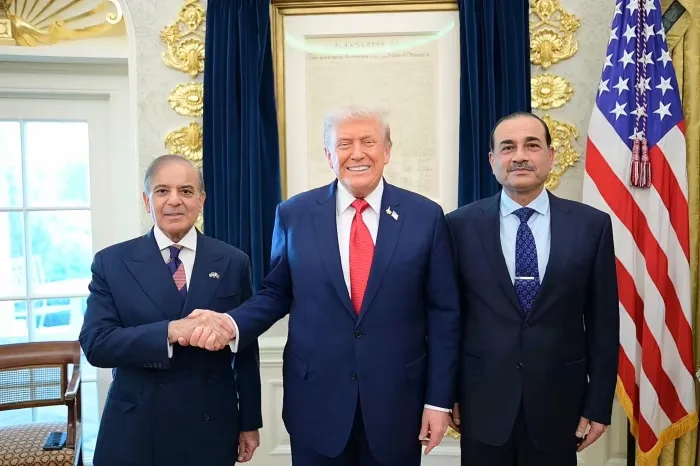
One lunch, June 2025. Civilian officials not invited.
One Nobel nomination. Gratefully submitted.
One seat on the Board of Peace.
One stablecoin memorandum. One hotel memorandum. One limited drone order.
One Treasury facility, $10 billion requested. Status: unanswered.
Balance carried forward: the Democrats.
ISLAMABAD. I make it a habit to read my country’s foreign policy in the foreign press, because at home it is classified. This week the foreign press was Reuters, the reporter was Ariba Shahid and the headline was one that no Foreign Office in the world would have chosen: “Pakistan’s leaders dread US Democrats’ win but its households are praying for it.”
The Wire Reads the Ledger
According to Reuters, Pakistan’s leaders spent two years courting Donald Trump and after the Democrats’ win in Tuesday’s congressional vote they are bracing for scrutiny of their access to the White House. Analysts told the agency the outcome is “far more worrying” for the government and the powerful military than for anyone else. The principal channel, Reuters says, was the army chief, Field Marshal Asim Munir, whom Mr Trump has repeatedly called his “favourite field marshal.” In June 2025 the two had a lunch that took place without Pakistani civilian officials present. The military says the talks went beyond security to cooperation in mining, energy and cryptocurrency.
A favourite is a precarious thing. Its security depends entirely on the person who keeps favourites; and as of Tuesday, on how many seats that person still controls.
What the Courtship Bought
The list of gestures is long. Reuters notes that Pakistan joined Mr Trump’s Board of Peace and nominated him for the Nobel Peace Prize, crediting him with helping end the May 2025 conflict with India, a role New Delhi denies. Islamabad relayed messages between Washington and Tehran and hosted US-Iran talk in April. The resulting Islamabad Agreement, Reuters says, quickly faltered.
The receipts are shorter. The US Export-Import Bank approved $1.25 billion in December 2025 for the Reko Diq copper and gold project. Pakistan’s “signature $10 billion request” for a US Treasury facility, Reuters reports, remains unanswered. They are different instruments and I do not pretend they are comparable, but the arithmetic is there for anyone who wants it: $1.25 billion is 12.5 percent of $10 billion and the first figure is for a mine. Reuters’s own judgment is that the courtship has not yet produced clear economic gains.
The Deals Under the Lamp
Reuters also lists the arrangements that a Democratic Congress might care to read. Islamabad signed memoranda to explore payments in USD1, a stablecoin issued by the Trump-linked World Liberty Financial. A memorandum to redevelop Manhattan’s Roosevelt Hotel was negotiated by the envoy Steve Witkoff. Pakistan placed a limited drone order with Powerus, whose investors include Donald Trump Jr. and Eric Trump. Asked about Powerus in September, White House spokeswoman Anna Kelly told Reuters: “There are no conflicts of interest.”
I allege nothing. Reuters alleges nothing and the White House denies everything. What I observe is the architecture: a country asking for a $10 billion Treasury facility was, in the same period, negotiating the redevelopment of a hotel and the exploration of a stablecoin. In a better-managed republic, one might have sent the Treasury request first.
The Experts Are Unkind
Husain Haqqani, a former Pakistani ambassador to Washington, told Reuters that Pakistan’s leaders had “built a transactional relationship” with Mr Trump’s team, that some arrangements involving the president’s friends and relatives “might not last,” and that “Pakistan seems totally unprepared for that scrutiny.” Michael Kugelman of the Atlantic Council said the risk for Pakistan is that it “put so many of its diplomatic eggs in the White House basket” that “it won’t have anything left for the Democrats.”
In fairness, Mr Kugelman also offered a consolation. Pakistan’s counterterrorism cooperation and Iran diplomacy, he argued, have bipartisan support and Democrats would be more likely to blame problematic deals on Mr Trump than on Pakistan. It is the first time in months that a foreign analyst has described the country’s position as “probably blameless, if lucky.”
Two Elections in One Country
The household view, as Reuters found it in Karachi, is different. A resident, Sajjad Ali, said: “We want peace, economic improvement and a reduction in the rising oil prices.” Another, Asim Zafar, said a Democratic result could “bring changes in important policies.” These are the voices of an import-reliant country of more than 240 million people, where war-inflated oil prices weigh on most households. The same week, you may recall, the nation was told to be grateful for a petrol cut of Rs3.40.
So, the leaders dread the result and the households pray for it. A country in which the state and the citizen hope for opposite outcomes in the same foreign election does not have one foreign policy. It has two; and only one of them has a lunch.
The Facade, Seen from Abroad
The foreign view of the home front is no kinder. When the emergency was imposed in Khyber Pakhtunkhwa on 11 October, Amnesty International’s Babu Ram Pant said that “emergency measures are not a blank cheque to crack down on human rights, silence dissent or concentrate power,” and raised concern about internet disruptions and military deployment. Pakistan presents itself abroad as the indispensable mediator, trusted by Washington and Tehran at once. At home the same state has suspended a provincial government and found that its High Court could be made to wait. Both pictures are, I am sure, equally true. They are simply not meant to be viewed from the same chair.