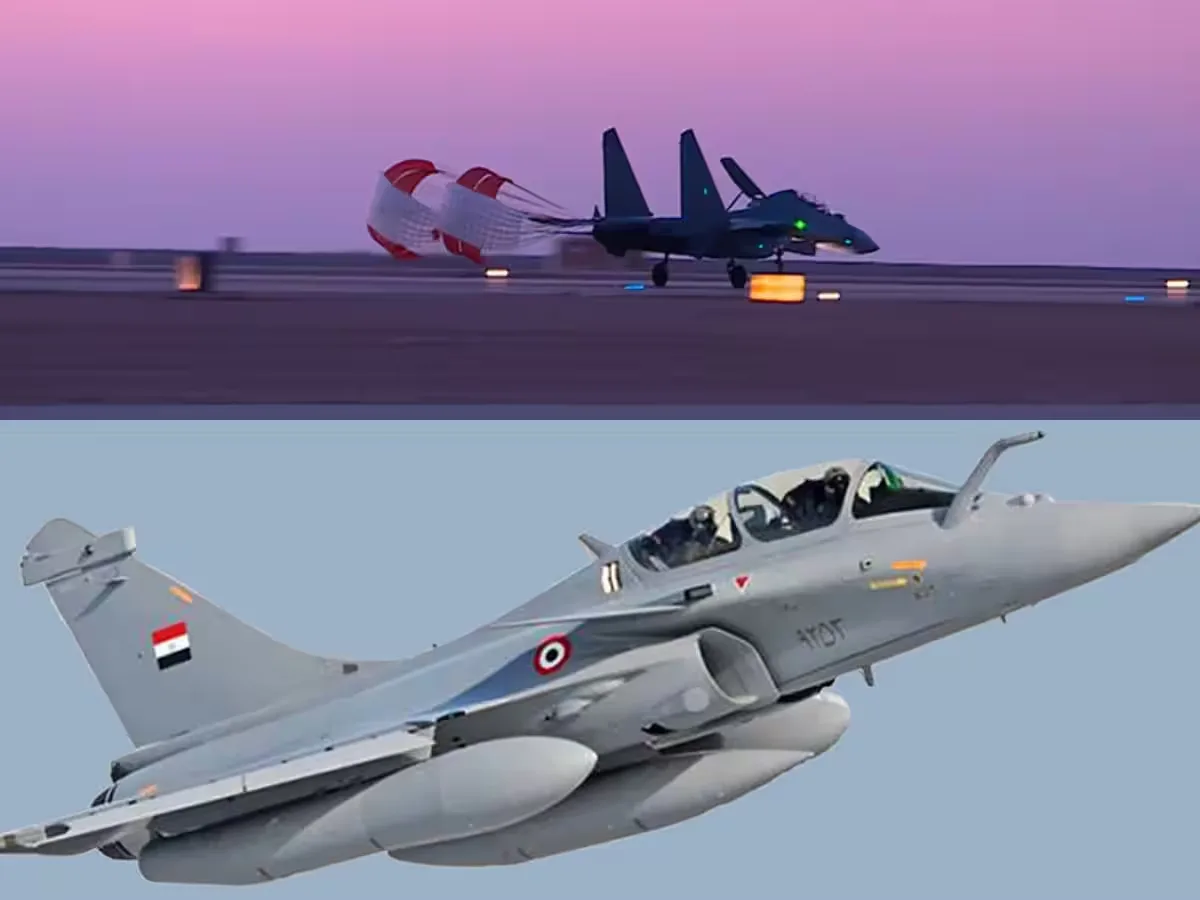
The reported confrontation between Egypt’s French-made Rafale fighters and China’s J-16 aircraft during Exercise Eagles of Civilization 2026 has provided an unusual opportunity to examine two competing approaches to modern airpower. Beyond the debate over which aircraft performed better, the exercise has highlighted a more consequential question: whether air superiority is determined by the individual fighter or by the wider combat system supporting it.
The joint exercise, conducted between the Egyptian and Chinese air forces from August into early September, marked the first reported combat training between China’s J-16 and a Western-designed Rafale. Beijing deployed a substantial aviation package, including J-16 fighters, YU-20 aerial refuelling aircraft, KJ-500 airborne early warning and control aircraft, and supporting platforms.
The deployment itself was significant. Chinese aircraft travelled more than 6,000 kilometres to reach Egypt, demonstrating the ability to move a combat aviation package beyond China's immediate neighbourhood and sustain joint training with a foreign air force.
But the exercise attracted greater attention after competing accounts emerged about the performance of the two fighters.
Initial claims circulating on Chinese social media suggested that the J-16 had substantially outperformed the Rafale in simulated engagements. Subsequent reporting by Defence Security Asia, however, cited accounts suggesting that Chinese pilots recognised the Rafale's advantages in close-range manoeuvrability, particularly its ability to point its nose rapidly towards an opposing aircraft.
Neither side has published comprehensive engagement scores, telemetry or independently verifiable results. The reported encounters therefore cannot establish an overall winner. They do, however, offer an opportunity to examine the different strengths of the aircraft and the systems supporting them.
The Rafale's advantage in close-range combat
The Rafale was designed around a combination of manoeuvrability, sensor integration and multirole flexibility. Its canard-delta configuration contributes to its handling characteristics, particularly during demanding manoeuvres at close range.
In a visual-range engagement, the ability to change direction rapidly and bring the aircraft's nose towards an opponent can create a potential firing opportunity. The Rafale's agility and high-angle-of-attack control are relevant in this context.
However, close-range manoeuvrability is only one part of aerial combat. A fighter's ability to maintain energy, detect an opponent, employ weapons and coordinate with other aircraft can be equally important.
The J-16 approaches the problem differently. Derived from the Russian Su-27 family, it is a larger, twin-engine multirole fighter designed to carry substantial weapons loads and operate over considerable distances. Its size and payload capacity give it a different operational profile from the Rafale.
The comparison is therefore not simply about which aircraft can turn more sharply. It concerns how different design priorities translate into performance under varying combat conditions.
China's broader airpower package
Perhaps the most significant aspect of the Egyptian exercise was China's decision to deploy supporting aircraft alongside its fighters.
The KJ-500 airborne early warning and control aircraft can provide surveillance and help coordinate fighter formations. The YU-20 tanker extends operational endurance, while specialised electronic warfare platforms can contribute to the disruption of opposing sensors and communications.
This combination reflects an important development in modern air warfare. A fighter does not operate in isolation. Its effectiveness increasingly depends on information supplied by other platforms, the ability to coordinate engagements and the availability of logistical support.
Electronic warfare is particularly important. Disrupting an opponent's radar or communications can complicate detection and targeting, potentially creating opportunities for friendly aircraft. But claims about the effectiveness of Chinese electronic warfare during the Egyptian exercise remain difficult to assess without technical data or independently verified results.
The reported interest shown by Egyptian personnel in Chinese electronic warfare capabilities is nevertheless noteworthy. It suggests that the exercise provided an opportunity to examine not only the J-16 but also the wider operational system supporting it.
For China, this was also an opportunity to demonstrate that its air force can deploy beyond its immediate region with a combination of combat and support aircraft.
Egypt's strategic balancing act
The exercise also reflects Egypt's expanding military engagement with China.
Cairo operates a diverse inventory of combat aircraft, including French Rafales, American F-16s and Russian MiG-29s. Training with different partners gives the Egyptian Air Force exposure to varied operational approaches and equipment.
China's participation provides another avenue for military cooperation without necessarily indicating a fundamental shift in Egypt's defence relationships. Cairo continues to maintain important security ties with Western countries while exploring additional partnerships.
For Beijing, the exercise offers more than a training opportunity. International military engagements allow China to demonstrate its aircraft and supporting systems to potential defence customers. Such exposure can strengthen its position in a competitive global arms market.
However, the distinction between demonstrating a capability and independently validating it remains important. A successful overseas deployment does not automatically establish how an aircraft or its supporting systems would perform in a contested operational environment.
Why the exercise matters to India
For India, the Rafale-J-16 encounter deserves attention because the Indian Air Force also operates the French fighter, while China continues to modernise and expand the capabilities of the People's Liberation Army Air Force.
The Egyptian experience, however, cannot be directly translated into an India-China air combat scenario. Indian Rafales operate with different configurations, weapons, mission data and operational procedures. The training standards, tactics and supporting infrastructure of the Indian Air Force also differ from those of Egypt.
What India can examine is the broader operational lesson emerging from China's deployment.
The combination of fighters, airborne early warning, electronic warfare and aerial refuelling demonstrates the importance Beijing places on integrated air operations. This is particularly relevant in a region where geographical distances, mountainous terrain and competing air-defence systems can complicate military planning.
The ability to coordinate different platforms, maintain situational awareness and sustain operations over distance may prove as important as the performance of individual fighters.
India's response must therefore extend beyond comparisons between aircraft specifications. Investment in airborne surveillance, electronic warfare, secure communications, aerial refuelling and integrated command systems remains central to developing a credible air combat capability.
The Rafale's strengths should be assessed within this wider framework rather than treated as a guarantee of superiority in every possible engagement.
The limits of drawing conclusions
The competing claims surrounding the Egyptian exercise illustrate how military training can quickly become an information contest.
Footage of aircraft manoeuvring together does not establish the outcome of a simulated engagement. Nor does a pilot's assessment of an opponent's handling characteristics amount to a comprehensive comparison of combat effectiveness.
The absence of publicly available engagement records, weapon-simulation data and detailed exercise conditions makes definitive conclusions premature.
The distinction matters because such claims can influence public perceptions and potentially shape the international defence market. Aircraft manufacturers and their supporters have strong incentives to highlight favourable demonstrations, but military procurement decisions require evidence extending well beyond promotional material.
The exercise should instead be viewed as a valuable demonstration of different approaches to airpower. The Rafale's reported close-combat advantages and China's broader supporting-aircraft package highlight capabilities that serve different operational purposes.
Ultimately, modern air superiority is not secured by a single fighter's manoeuvrability or weapons capacity. It depends on the ability to combine aircraft performance with surveillance, electronic warfare, command coordination, logistics and trained personnel.
Egypt's exercise with China has brought that reality into focus. The most important lesson is not that one aircraft has conclusively defeated another, but that the future of air combat will increasingly be shaped by the effectiveness of the entire system operating behind the fighter.