The arrival of US President Donald Trump in China for the 2026 Asia-Pacific Economic Cooperation (APEC) summit presents Beijing with an opportunity that extends well beyond trade negotiations. By hosting the leaders of the world's major powers in Shenzhen, Chinese President Xi Jinping is positioning his country as a central diplomatic actor at a time when Washington is struggling to reconcile its economic ambitions, strategic competition with China and increasingly complicated international commitments.
The symbolism is difficult to miss. Trump has arrived in China seeking engagement with Xi, while Russian President Vladimir Putin is also attending the summit. The possibility of an unprecedented trilateral meeting involving the three leaders places Beijing at the centre of an extraordinary diplomatic gathering. For Xi, the occasion offers an opportunity to demonstrate that China is not merely responding to American initiatives but increasingly helping determine the setting and terms of major international discussions.
The contrast between Washington's approach and Beijing's diplomatic presentation is particularly significant. Trump's foreign policy has relied heavily on tariffs, bilateral bargaining and direct negotiations between national leaders. Xi, meanwhile, has used multilateral platforms to present China as a supporter of economic cooperation, regional stability and international trade. Whether Beijing consistently follows these principles in practice is a separate question. The immediate diplomatic advantage lies in its ability to shape the narrative while hosting the discussions.
Shenzhen provides an appropriate setting for that message. Once a relatively small settlement, the city has developed into one of China's most important manufacturing, technology and financial centres. Its transformation reflects the country's integration into global supply chains and its emergence as a major industrial power. By hosting APEC there, Beijing is presenting China's economic development as evidence of its capacity to participate in and shape the future of the global economy.
Xi's message to business leaders has emphasised open trade, investment and equitable growth. He has also indicated that China is prepared to reduce tariffs, expand market access and undertake reforms involving regulations and standards. These statements are aimed not only at Washington but also at countries increasingly concerned about the consequences of trade fragmentation.
There is an evident strategic calculation behind this approach. American tariffs and technology restrictions have encouraged several economies to reconsider their dependence on the US market. China is seeking to position itself as an alternative economic partner, particularly for countries that want to maintain access to both major markets without becoming directly involved in their strategic rivalry.
However, Beijing's appeal to open trade comes with contradictions. China's enormous manufacturing capacity, industrial subsidies and export expansion have generated concerns among trading partners about market imbalances and competition with domestic industries. Its trade surplus has continued to attract international scrutiny. Governments across Europe, Asia and North America are increasingly questioning whether access to the Chinese market is genuinely reciprocal.
China's diplomatic message will therefore be judged not only by its statements at APEC but also by the extent to which it addresses these concerns through actual economic policy.
For Trump, the summit presents a different set of priorities. His administration wants to preserve the trade truce with Beijing, secure commercial advantages and maintain American leadership in advanced technology. Yet the instruments used to achieve these objectives have created uncertainty among Washington's partners. Tariffs intended to pressure China have also affected other economies, while restrictions on advanced semiconductor exports have become a persistent source of tension.
The technology dispute is particularly important. Advanced processors manufactured by American companies remain central to the development of artificial intelligence and high-performance computing. Washington wants to prevent sensitive technologies from strengthening China's military and strategic capabilities. Beijing, meanwhile, is accelerating its efforts to develop domestic alternatives and reduce dependence on foreign suppliers.
This competition is unlikely to be resolved through a single presidential meeting. Even if Trump and Xi agree on a temporary understanding over trade, the underlying technological rivalry will remain. The United States will continue to protect its most sensitive technologies, while China will continue investing in semiconductor manufacturing, artificial intelligence and the infrastructure needed to support its ambitions.
Taiwan represents another difficult issue. Beijing considers the island part of its territory and opposes American military support for Taipei. Washington maintains its longstanding policy framework under which it provides Taiwan with defensive capabilities while preserving strategic ambiguity. Trump has indicated that he does not intend to raise Taiwan during his discussions with Xi, although he expects the Chinese leader to bring it up.
That position illustrates the transactional nature of the current engagement. Trump appears interested in securing progress on immediate economic and diplomatic issues, while Xi has an opportunity to press Washington on questions that Beijing considers central to its sovereignty and security interests. Whether the American President is prepared to make concessions remains uncertain.
The presence of Putin adds another dimension to the summit. Russia has increasingly depended on China for economic and diplomatic support since the invasion of Ukraine in 2022. Trade, energy cooperation and strategic coordination have strengthened the relationship between Moscow and Beijing. Putin's participation in a high-profile gathering alongside Trump and Xi allows Russia to demonstrate that it remains engaged with the world's major powers despite Western sanctions and diplomatic pressure.
For Xi, hosting both leaders reinforces China's image as a diplomatic centre capable of engaging competing international actors. But the proposed trilateral format also carries risks. A discussion involving Washington, Beijing and Moscow cannot automatically resolve conflicts affecting countries that are absent from the table. Ukraine, in particular, has reason to be concerned about any major-power understanding that could influence its future without its direct participation.
The nuclear question is another area where the interests of the three countries diverge. Trump has expressed interest in a new arms-control arrangement involving China and Russia following the expiration of the New START treaty between Washington and Moscow. Beijing, however, has resisted joining negotiations that would impose equivalent restrictions on a nuclear arsenal substantially smaller than those of the United States and Russia.
The challenge for Washington is to secure meaningful arms-control progress without creating an arrangement that Beijing considers fundamentally unequal. For China, the difficulty is balancing its desire for recognition as a major nuclear power with its reluctance to accept restrictions that could limit its expanding capabilities.
Beyond these high-profile negotiations, APEC itself remains important. The organisation brings together 21 economies accounting for a substantial share of global economic activity and trade. It provides a platform for discussions on supply chains, investment, digital trade and regional economic cooperation. Although its decisions are not legally binding, its ability to maintain dialogue among competing powers gives it considerable diplomatic relevance.
China wants to use this platform to reinforce the argument that regional prosperity depends on economic openness rather than geopolitical confrontation. Yet other APEC economies are unlikely to accept that argument without reservations. Many depend heavily on Chinese trade while also relying on American security partnerships and technological cooperation. Their preference is not necessarily to choose between Washington and Beijing but to preserve the freedom to work with both.
This is particularly relevant for Southeast Asian economies, Japan, South Korea and Australia. They must navigate an increasingly difficult environment in which economic interdependence with China coexists with security concerns about its regional ambitions. APEC provides an opportunity to maintain communication, but it cannot remove the strategic differences driving competition in the Indo-Pacific.
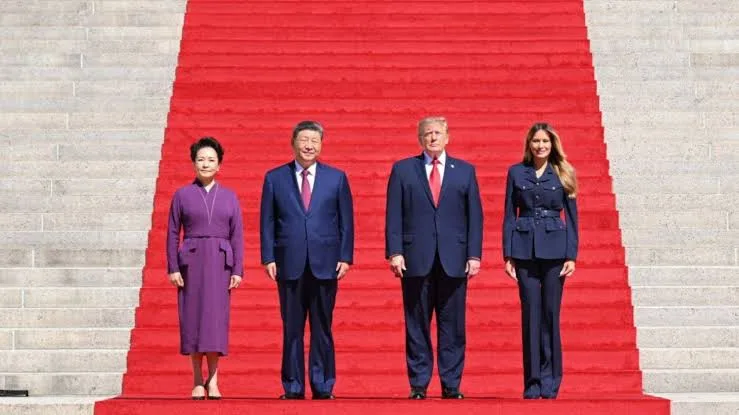
For Beijing, the summit's greatest value may therefore be diplomatic rather than economic. China is using its position as host to shape the international conversation, project confidence and demonstrate that Washington must engage with it as an indispensable global power. The welcome extended to Trump, including Xi's personal reception at the airport, reinforces the language of reciprocity and mutual respect that Beijing wants associated with the relationship.
But a carefully staged diplomatic welcome should not be mistaken for a resolution of strategic disagreements. China and the United States continue to differ over trade, Taiwan, technology restrictions, maritime security and the international order. The leaders may agree to keep channels open, but the structural competition between their countries will remain.
The larger question is whether Washington recognises that engagement with Beijing requires more than presidential diplomacy. American influence in the Asia-Pacific depends on its relationships with allies and partners, the credibility of its security commitments and the competitiveness of its technology and industrial base. A trade understanding with Xi cannot substitute for a coherent regional strategy.
Equally, Beijing cannot expect its diplomatic positioning to translate automatically into international confidence. Its economic influence is considerable, but concerns about market access, strategic coercion and regional security remain significant among neighbouring countries.
At APEC, Xi has the advantage of being the host, setting the diplomatic atmosphere and presenting China's preferred narrative of global cooperation. Trump has arrived with his own agenda, but the setting itself allows Beijing to project influence and reinforce its position in the international system.
The summit may produce agreements, temporary trade arrangements or carefully worded statements. Its more lasting significance, however, will lie in what it reveals about the changing balance of diplomatic influence. Washington remains a powerful actor, but it can no longer assume that it alone determines the framework within which global economic and strategic discussions take place.
China is welcoming America, but it is doing so from a position it has spent decades building. The question for Washington is whether it can engage Beijing without allowing the diplomatic momentum of the moment to obscure the deeper competition shaping the Indo-Pacific.