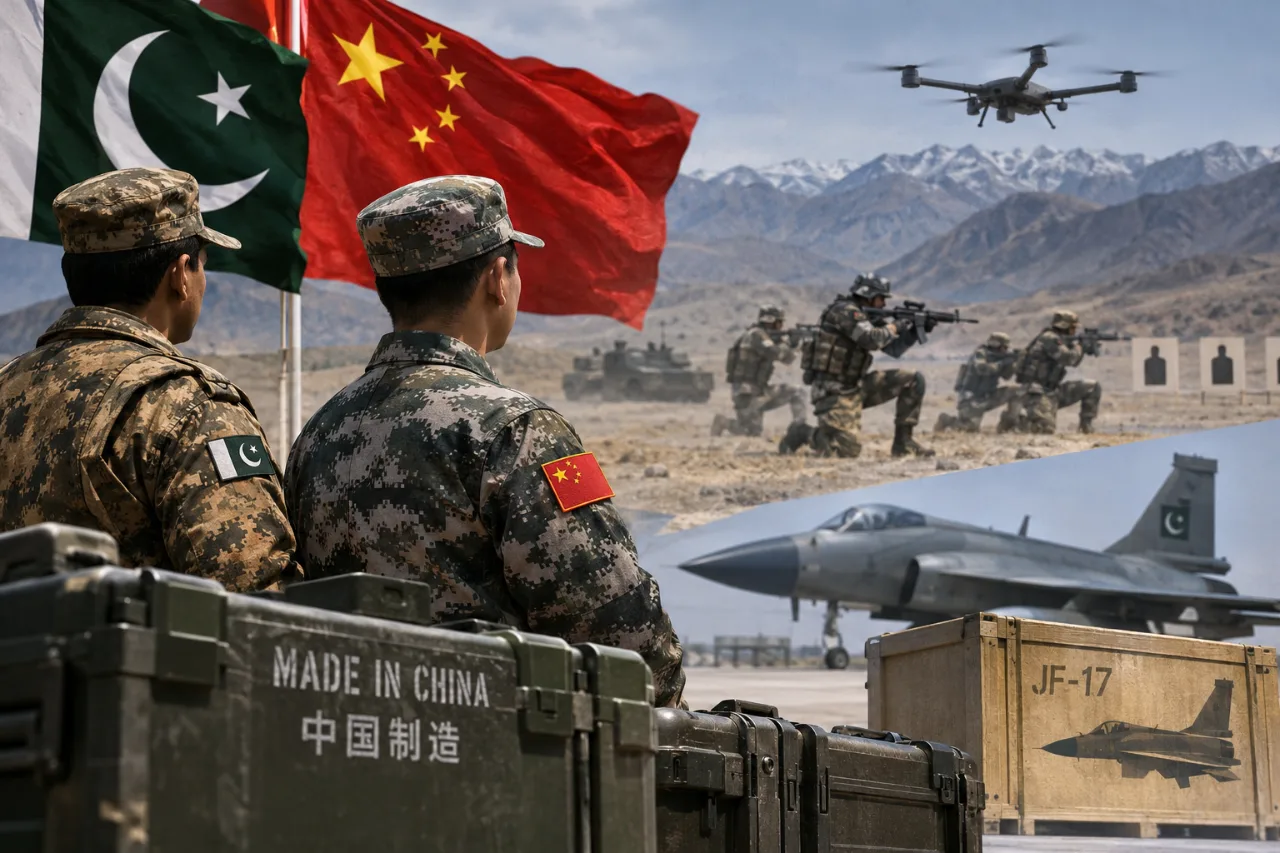
ISLAMABAD. A proud week for our armed forces and I do not use the phrase lightly. For nine days in October, from the 14th to the 22nd, the Pakistan Army trained side by side with the People's Liberation Army at a base in Korla, in Xinjiang. It was, our friends in Beijing tell us, the first joint army training between the two countries. It took seventy-five years of brotherhood to get here and the brothers have rightly decided not to rush.
The programme was serious. According to China's defence ministry, the troops practised flying drones, hitting targets on the move and long-range sniping, followed by joint command and live exercises. In the final phase they worked in mixed formations under what the ministry describes as joint command, with units grouped by task. I am told the word for this is interoperability and I have looked it up. It means that two armies can operate together. It does not say which one brought the equipment.
Who brought the kit
The Global Times, which tends to know such things, reported that China supplied all the weapons and equipment for the exercise. Our own Center for International Strategic Studies, in a more careful essay, noted that reports have not given the size of the contingents and called the exercise modest in scale. At the opening ceremony, the Pakistani troops, I read, observed some Chinese weapons and equipment. Observed. There is a dignity in that verb. We came as a great army of the Islamic world and we were shown the toys.
Do not mistake this for a complaint. A guest who arrives with no equipment and leaves with a deeper understanding of someone else's is merely continuing a tradition. SIPRI says China supplied 81 per cent of Pakistan's arms imports in 2020 to 2024, up from 74 per cent the period before. The latest five years put the figure at about 80 per cent. Pakistan, for its part, took 63 per cent of everything China sold abroad in that time, some 5.28 billion dollars of it. We are not a customer. We are the shop window.
Someone in Washington has noticed. A US congressional commission, as reported by the South China Morning Post, said Beijing used the conflict of May 2025 to test and advertise its weapons. It added that calling it a proxy war might overstate China's part. I find this reassuring, in the way that a doctor who says you are merely a tester of the product rather than a victim of it is reassuring.
The brotherhood goes east
Our friends at the air force have a further plan. In January the Pakistan Air Force chief held talks in Islamabad with his Bangladeshi counterpart on selling the JF-17 Thunder, helping to maintain Bangladesh's ageing fleet and integrating air-defence radars, ISPR said. The JF-17, a jet we describe with great feeling as ours, was co-developed with China. An Australian analysis points out that its main radar is the Chinese KLJ-7A, its principal air-to-air missile is the Chinese PL-15 and its supply chain runs through Chinese and Pakistani firms. The same analysis calls the sale a trilateral deal in structure, with Beijing as the quiet principal. In May a PAF transport landed in Dhaka carrying one heavy crate and Asia Times reported that Bangladesh had received a JF-17 simulator.
So, we are now exporting a Chinese jet, with Chinese radar and Chinese missiles, to a third country, with Chinese blessing and calling it a boom in Pakistani defence manufacturing. I have worked in this business a long time and I have rarely seen a more gracious way to be the middleman. The analyst's figures, 400 to 720 million dollars of financing, are an estimate. I would not worry about them. When a customer cannot pay, the lender is usually the same man who built the aircraft.
Far up the mountain, at about 4,700 metres, the Khunjerab Security Force and Chinese units held a joint patrol at Mantika Pass in September, Dawn reported. This is called deepening ties. It also means that, for the part of our frontier where the road is Chinese, the investment is Chinese and the headache is shared, the patrol is now Chinese too.
A very large army that trains abroad
What worries me, as a patriot, is the timing. The Director General of ISPR told the nation on 31 July that this year had already cost 819 martyred, among them 303 soldiers. The fighting is at Mir Ali, in Orakzai, in Kharan and on the Quetta highway, with kit that is, in the main, bought from the people who ran the drill. The counter-terrorism lesson was learned in Xinjiang and applied in Waziristan. I do not say the lesson is wrong. I note only that the instructor is usually the one who has never been shot at in Waziristan.
In fairness, the exercise teaches one thing no purchase order can. A force that imports four-fifths of its weapons and trains with the supplier on the supplier's soil is, in every sense that matters to a lawyer, interoperable. It can be joined at any time. It can also be unplugged.