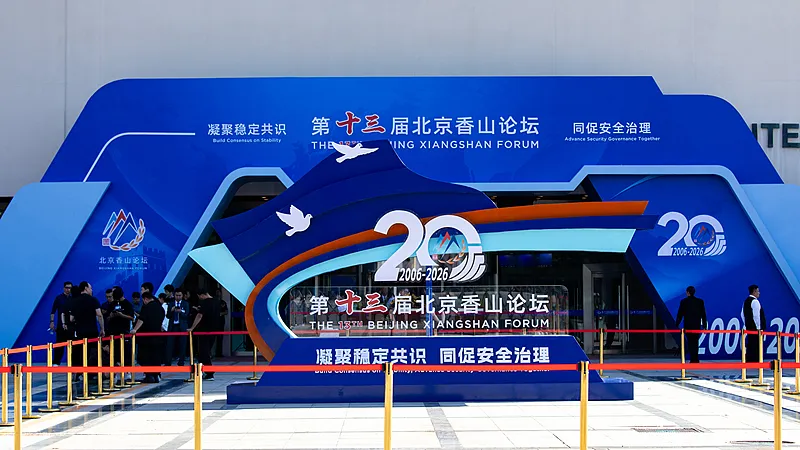
China has called for deeper international security cooperation as defence officials from nearly 100 countries, regions and international organisations gathered in Beijing for the 13th Beijing Xiangshan Forum.
Chinese Defence Minister Dong Jun used meetings with defence officials from Myanmar, Brunei, Belarus, Azerbaijan, Kyrgyzstan and Armenia, as well as ASEAN Secretary-General Kao Kim Hourn, to advocate greater military and security cooperation. The meetings took place alongside the annual forum, one of Beijing’s principal platforms for defence diplomacy and international security dialogue.
Dong said the Chinese military was prepared to strengthen cooperation with other countries to address common security challenges. He emphasised dialogue, mutual trust and practical cooperation as means of maintaining peace and stability, according to China’s account of the meetings.
The forum, held under the theme “Build Consensus on Stability, Advance Security Governance Together”, comes as conflicts, strategic competition and other security pressures continue to shape the international environment.
Dong linked China’s approach to its broader concept of building a “community with a shared future for humanity” and to its Global Security Initiative, which Beijing promotes as a framework for addressing international disputes through dialogue and cooperation.
Chinese officials argue that contemporary security challenges are increasingly interconnected and cannot be addressed solely through traditional military competition. The approach encompasses regional conflicts, terrorism, cyber threats and other non-traditional security risks.
Established in 2006, the Beijing Xiangshan Forum has developed into a regular venue for military officials, government representatives, international organisations and security experts. Its participation has expanded beyond its original regional focus, giving Beijing a platform to engage defence establishments from across Asia, Europe and other regions.
Dong described the forum as an international public platform based on equality, openness, inclusiveness and mutual learning. Beijing presents it as a venue where countries can discuss security issues outside the structures of traditional military alliances.
The latest forum focused on communication, cooperation and international security governance amid instability in global affairs. Discussions addressed regional stability and mechanisms intended to reduce the risk of conflict.
Dong’s separate meetings with defence representatives also highlighted the breadth of China’s military engagement. Contacts with Myanmar, Brunei and the ASEAN secretary-general reflected Beijing’s continuing emphasis on security relations in Southeast Asia, while meetings with Belarus, Azerbaijan, Kyrgyzstan and Armenia extended the diplomatic engagement across Central Asia, the Caucasus and Europe.
For China, defence exchanges and multilateral security forums are instruments for building military-to-military contacts and increasing mutual understanding. The meetings also provide opportunities for Beijing to advance its security concepts and deepen bilateral and multilateral relationships.
At the same time, China’s expanding defence diplomacy is taking place against a backdrop of wider geopolitical competition. Strategic disagreements, territorial disputes, military modernisation and changing security partnerships continue to complicate efforts to establish common approaches to international security.
The Xiangshan Forum therefore brings together countries with differing strategic interests and views of regional security. While some see engagement with China as a means of maintaining dialogue and cooperation, others scrutinise Beijing’s expanding military relationships and its broader security objectives.
The forum’s longer-term significance will depend in part on whether discussions can produce practical forms of cooperation among countries whose interests do not always align. For Beijing, however, the event provides an established platform from which to promote its preferred approach to international security governance and expand defence engagement with a wide range of countries.
The 2026 forum thus combined two elements of China’s defence diplomacy: direct military engagement with individual partners and a broader effort to shape international discussions about how security challenges should be managed.