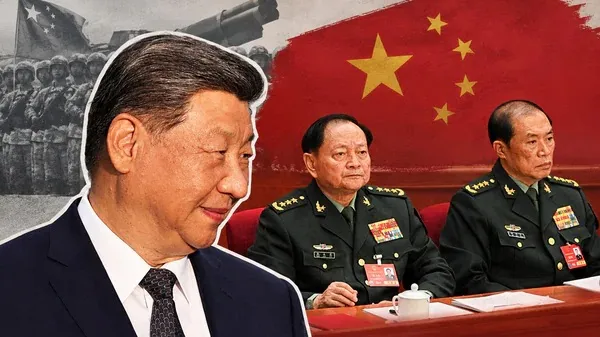
China has expelled two of its most senior military officers from the Communist Party and the armed forces, extending President Xi Jinping’s long-running campaign against corruption and political disloyalty into the highest levels of the People’s Liberation Army.
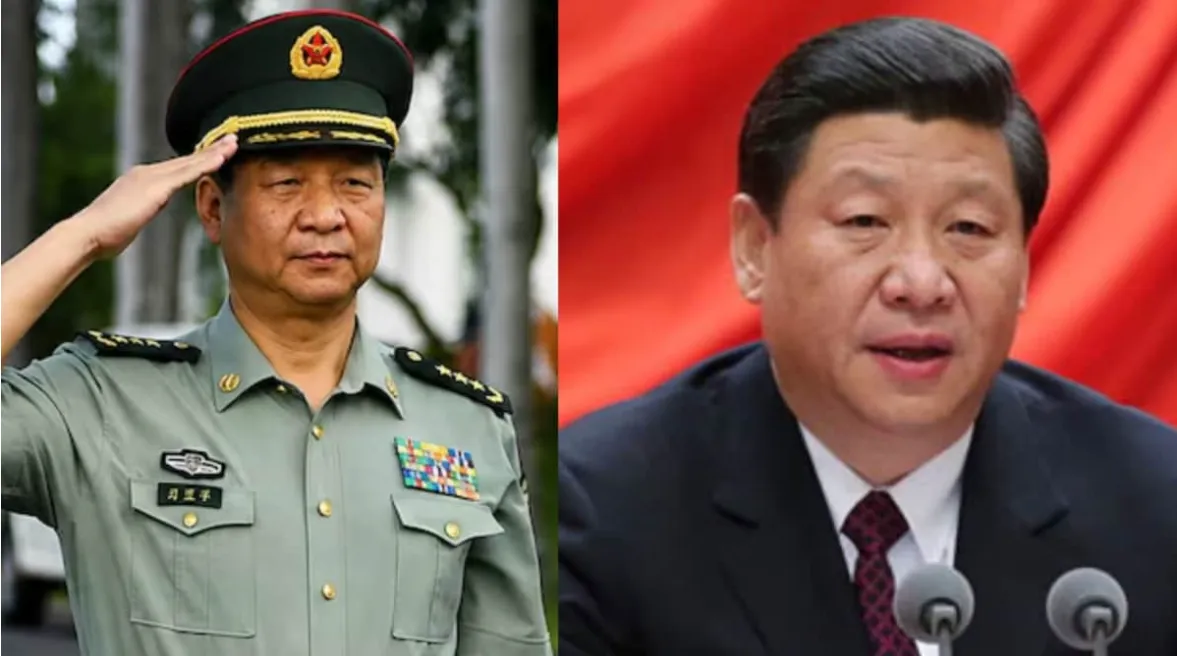
General Zhang Youxia, formerly a vice-chairman of the Central Military Commission and a member of the Communist Party’s Politburo, and General Liu Zhenli, formerly a CMC member and chief of its Joint Staff Department, were removed following investigations announced in January. Chinese state media said the two had committed serious disciplinary and legal violations and would face further proceedings through military legal authorities.
The expulsions are notable because of the positions the two men occupied and their military backgrounds. Zhang was the highest-ranking uniformed officer in the PLA beneath Xi and one of the few senior commanders with direct combat experience. Liu also had operational experience and held a central role in military planning and coordination.
Chinese authorities have accused both officers of political and economic misconduct. The allegations include forming cliques and factions, violating political discipline, using their positions to assist others with promotions, accepting money and gifts, abusing their offices and failing to properly supervise people around them. State media described the sums involved as exceptionally large. Their cases have been transferred to military prosecutors for further action.
The action against Zhang is particularly striking because of his longstanding association with Xi. Zhang and Xi had known each other from an early stage of their careers, and Zhang was widely regarded as a senior figure within Xi’s military leadership. His removal shows that the current campaign has reached figures who had previously occupied the highest levels of the command structure.
The latest move is part of a much broader restructuring of China’s military leadership under Xi, who has made political loyalty and discipline central elements of his control over the PLA.
Earlier stages of the campaign targeted senior officers associated with the previous leadership. Former Central Military Commission vice-chairmen Guo Boxiong and Xu Caihou were removed and investigated in 2014 and 2015. Subsequent cases widened to include other senior commanders and defence ministers, including Wei Fenghe and Li Shangfu. Investigations have also affected senior officers in the Rocket Force and other parts of the military.
The campaign has therefore evolved beyond the removal of officials associated with earlier patronage networks. Officers appointed or promoted during Xi’s tenure have also been investigated or dismissed, reinforcing the leadership’s emphasis on political discipline and internal control.
For the PLA, the effect on command experience is harder to measure. China has spent years modernising its armed forces, investing in advanced weapons, joint operations and training. But the removal of experienced senior commanders raises questions about how institutional knowledge and operational judgement are being transferred to the next generation of leaders.
Zhang and Liu both had experience connected to China’s 1979 war with Vietnam. Their careers therefore spanned an earlier period of PLA operations that is difficult to replicate through training alone. At the same time, combat experience from several decades ago cannot by itself establish how effectively a commander would perform in a contemporary conflict involving precision weapons, cyber operations, space capabilities and highly integrated joint forces.
The more immediate issue is command continuity. A large-scale military operation would require coordination across the PLA’s different services and supporting organisations, as well as rapid decisions based on incomplete and changing information. Whether repeated leadership turnover affects that process cannot be established from the expulsions alone.
There is also a broader institutional question. Military organisations depend on commanders being able to identify weaknesses and communicate unwelcome information to senior political leaders. A system in which political loyalty is heavily emphasised may create tensions between the requirement for ideological discipline and the need for candid professional assessments, although the extent of any such effect inside the PLA remains difficult to determine from publicly available information.
The issue has particular relevance to Taiwan, where any major military contingency would place extensive demands on China’s command structure. An operation across the Taiwan Strait would require coordination among naval, air, ground, missile and other forces, making planning and command integration critical. The removal of senior commanders does not demonstrate that the PLA lacks those capabilities, but it adds to questions about how leadership changes could affect decision-making during a crisis.
The purge has also altered the composition of the Central Military Commission, China’s highest military decision-making body. The removals of Zhang and Liu follow the earlier departures of several other senior CMC figures, including former Defence Minister Li Shangfu, former vice-chairman He Weidong and former Political Work Department chief Miao Hua. The turnover has left Xi with a significantly changed senior military leadership team.
Beijing has presented the campaign primarily as an effort to enforce discipline, combat corruption and protect the Communist Party’s control over the armed forces. The allegations against Zhang and Liu also went beyond financial misconduct, with official statements explicitly referring to disloyalty and faction-building.
For Xi, the removals reinforce the principle that seniority and previous political standing do not shield military officials from investigation. For the PLA, the challenge is to maintain command stability and professional competence while its senior ranks undergo an unusually extensive turnover.
China’s military continues to possess substantial resources and has undergone rapid modernisation. The longer-term question is whether Beijing can sustain that transformation while repeatedly replacing senior commanders and maintaining a leadership structure that combines political loyalty with the independent professional judgement required for complex military planning.