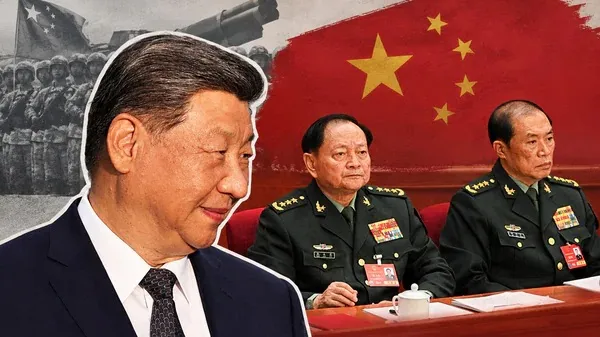
The removal of two senior Chinese military commanders has brought renewed attention to the scale of Xi Jinping’s effort to reshape the People’s Liberation Army and to the possible consequences of repeatedly replacing senior officers at the top of the command structure.
Generals Zhang Youxia and Liu Zhenli were expelled from China’s military leadership on September 21, according to the material supplied. Beijing has framed the campaign around corruption, discipline and loyalty to the Communist Party. But the departure of two commanders with extensive military experience raises a separate question: how does the PLA preserve operational expertise while undergoing an increasingly broad political purge?
Zhang, a former vice chairman of the Central Military Commission and Politburo member, and Liu, former chief of the Joint Staff Department, were among the senior officers identified in the material as having direct experience of the 1979 China-Vietnam conflict. Their careers placed them within a generation of commanders whose professional backgrounds were shaped by actual combat rather than exclusively by peacetime training and military modernisation.
The significance of their removal is therefore not limited to the positions they held. It also concerns the loss of senior-level experience in planning, command and the management of military operations.
Xi has spent more than a decade reorganising the PLA and strengthening the Communist Party’s control over the armed forces. The campaign initially focused heavily on senior figures associated with earlier leadership networks. The investigations of former Central Military Commission vice chairmen Guo Boxiong and Xu Caihou in 2014 and 2015 were among the most prominent examples.
Other senior officers, including Fang Fenghui, were subsequently investigated. Over time, however, the campaign extended beyond officials associated with previous power networks. Former defence ministers Wei Fenghe and Li Shangfu were also removed amid investigations, while senior figures associated with the Rocket Force came under scrutiny.
That broader pattern is important in understanding the latest changes. The purges have not been confined to officers who were clearly identified with political networks predating Xi. Officials who rose during his tenure have also faced investigations and removal.
Zhang’s case is particularly notable because of his longstanding relationship with the Chinese military establishment and his seniority within the system. His removal, as presented in the supplied material, demonstrates the extent to which even highly placed officers can be affected when they come under suspicion.
For the PLA, the challenge is not simply replacing individuals. Modern armed forces depend on institutional knowledge accumulated over years of command, training and operational planning. Technology can improve surveillance, weapons, communications and logistics, but it cannot automatically reproduce the judgement developed through experience.
Liu’s former position at the Joint Staff Department was particularly relevant to military planning and coordination across different branches. A major military operation would require the Army, Navy, Air Force, Rocket Force and supporting organisations to operate within a closely coordinated command structure.
That requirement becomes particularly important in any scenario involving Taiwan. A large-scale operation across the Taiwan Strait would involve complex planning, joint operations and rapidly changing conditions. The effectiveness of such an operation would depend not only on China’s weapons and personnel but also on the ability of commanders to coordinate forces and respond to unexpected developments.
The removal of experienced commanders does not establish that the PLA is operationally weaker. The supplied material does not provide evidence that the recent purge has directly reduced China’s ability to conduct military operations. It does, however, identify a potential institutional tension between political control and professional military advice.
A military leadership system built around strict political loyalty may encourage discipline and reinforce central authority. At the same time, commanders need to be able to identify weaknesses and provide assessments that may be unwelcome to political leaders.
This is particularly important in areas such as training, logistics, equipment and operational planning. If officers believe that criticism could be interpreted as political disloyalty, there is a potential risk that problems are communicated less openly. The supplied material presents this as a concern rather than an established consequence of the current purge.
Xi’s approach reflects his broader effort to ensure that the PLA remains firmly under Communist Party control. Beijing has consistently linked military discipline and political loyalty with the effectiveness of the armed forces, while presenting corruption as a threat to military capability.
The difficulty for the PLA is maintaining that political cohesion without weakening the professional independence required for effective military advice. Senior commanders must ultimately do more than demonstrate loyalty; they must also provide accurate assessments of capabilities, risks and operational limitations.
China has invested heavily in military modernisation over the past decade, expanding its technological capabilities and restructuring its armed forces. The removal of senior commanders therefore comes against the backdrop of a military that is simultaneously becoming more sophisticated and undergoing significant organisational change.
The longer-term effect of the purge will depend on how effectively the PLA replaces experienced commanders, preserves institutional knowledge and develops a new generation of senior officers. The central question is not whether China can maintain political control over its military, but whether that control can coexist with the candid professional advice required at the highest levels of command.
For regional security, particularly around Taiwan and the wider Indo-Pacific, the evolution of China’s military leadership will remain significant. The departure of Zhang Youxia and Liu Zhenli does not by itself demonstrate a decline in Chinese military capability. It does, however, illustrate the scale of the transformation underway inside the PLA and the continuing challenge of balancing political loyalty with military professionalism.