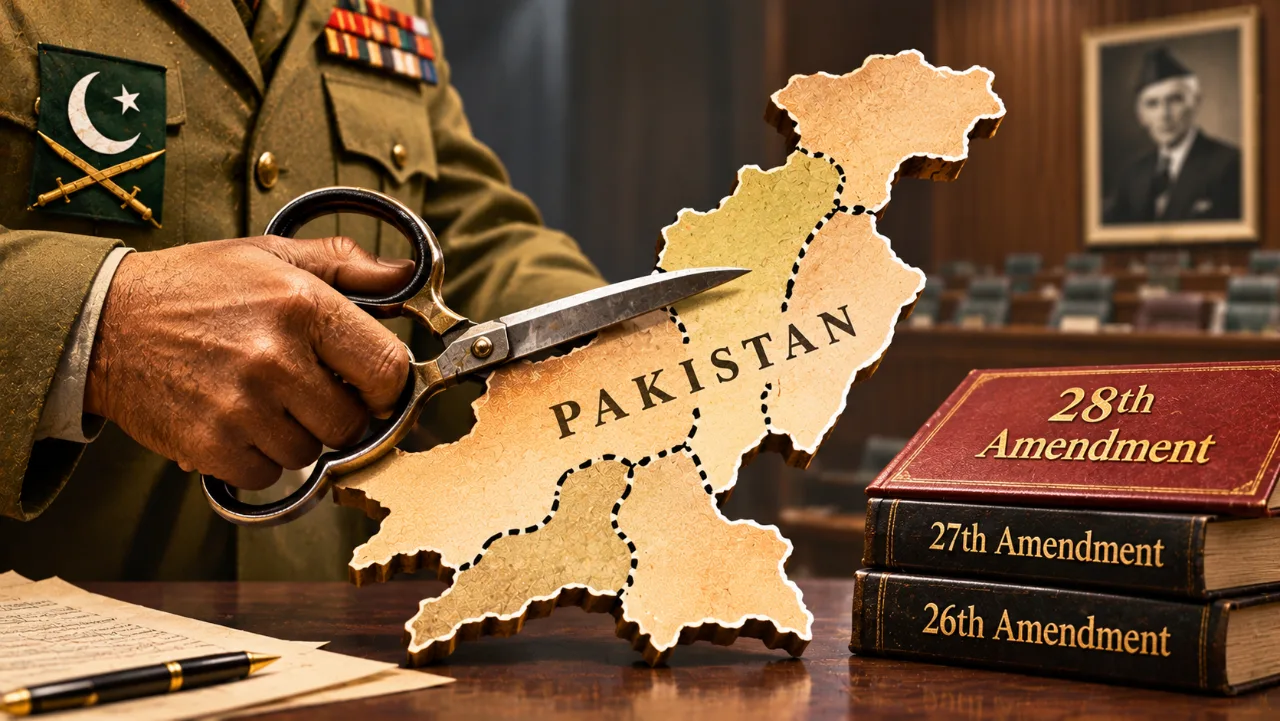
A state that cannot stop kidnappings in Balochistan, cannot count its own border dead and has had to suspend an elected government in Khyber Pakhtunkhwa has arrived at a bold diagnosis of its troubles; the map is wrong. In the autumn of 2026, the response to a collapsing system of governance, as one minister put it, is to cut the provinces into smaller pieces and hope that the pieces are easier to manage. The proposal is called the 28th Amendment. Nobody will say who drafted it.
The Minister Who Said the System Had Collapsed
In late July, Interior Minister Mohsin Naqvi said the governance system had "collapsed." According to ThePrint, the military's media wing, DG-ISPR, publicly backed him, a curious intervention by a uniformed press office on a question of provincial boundaries on which the Constitution gives it no role. On 5th September, Naqvi said he would not back down and that new units should follow popular will rather than ethnicity. At the Pakistan Economic Summit, he called the creation of new provinces the only solution to the country's condition.
The Supreme Court Bar Association's president, Haroonur Rashid, endorsed the idea. The Pakistan Bar Council took the opposite line at its 250th meeting; constitutional matters must stay within the Constitution's framework, through parliament and with national consensus.
The Map, As Leaked
On 15th August, Dawn reported that an unnamed senior government functionary had described the options. In the first, Karachi and Gwadar would come under federal administrative control, with the rest of Sindh remaining one province. Balochistan would be split into two, Punjab into three and Khyber Pakhtunkhwa, complicated by the FATA merger, into Pakhtun and Hazara regions. In the second, funds for local governments would be routed directly through the federation rather than through the provinces. The functionary admitted that the idea was at an "initial stage" and that consensus among parties which appear opposed would be "difficult."
Read the first option as a cartographer, not a constitutional lawyer. The country's largest city and port and the port at the heart of the China-Pakistan Economic Corridor, would pass to federal control. That is not decentralisation. It is a seizure of the two places where the money lands, presented as a gift to the people who live around them. The reported thinking also extends to the revenue pool. ThePrint reports the federal government wants a larger share for debt and defence, against the 57.5 percent that provinces currently receive.
Sindh Says No, Unanimously
The answer from Karachi came on 3rd September. The Sindh Assembly passed a resolution rejecting any change to Sindh's territorial limits, citing Article 239(4), which requires a two-thirds majority of the provincial assembly for such a change. The PPP, a key partner in the federal coalition, opposes dividing Sindh. The MQM-Pakistan boycotted the session, which is as close as that party gets to a position on this issue.
On 27th October, PPP chairman Bilawal Bhutto-Zardari told reporters in Karachi that the Sindh Assembly had "put a full stop to the debate on creating new provinces out of Sindh," and that the federal government had not held any discussions on the proposed amendment with his party. The party that must supply the votes, in other words, has not been asked. In that sentence lies the whole method; float the map through anonymous functionaries and the military's press wing, deny that anyone is drafting it and discover consensus after the fact.
Civil War, Maharashtra and Other Understatements
Not everyone is calm. Ayesha Siddiqa, quoted by ThePrint, warned: "There's going to be a civil war in Sindh if 28th Amendment comes to a pass." Husain Haqqani described the plan as "attempting to create a Maharashtra without Mumbai in it." These are opinions of two long-standing critics of the establishment and the amendment had not been tabled as of late October, so they describe a hypothetical. But the hypothetical is the point. A government that has to be warned about civil war before it has published its text has a strange idea of consultation.
The Third Amendment in a Series
Context matters. The 26th Amendment was passed in 2024. The 27th, passed by the Senate on 13 November 2025 and signed by President Zardari the same day, created the post of Chief of Defence Forces, abolished the Chairman Joint Chiefs of Staff Committee, granted lifetime ranks and privileges to officers holding the rank of Field Marshal and set up the Federal Constitutional Court that now hears the country's constitutional questions. Reports said it also gave immunity to the Army Chief. The Supreme Court lost its constitutional jurisdiction. A parliament that has learned how to produce a two-thirds majority on demand is not a parliament likely to be worried by a procedural inconvenience like Article 239(4).
The pattern is a ratchet; first the command structure, then the court, now the map. Each step is presented as technical; each is accompanied by a denial and each leaves the elected institution slightly smaller than before.
A Raj Idea with a Raj Record
The idea is not new and neither is its lesson. In 1905 the British partitioned Bengal for what they called administrative convenience and reversed it in 1911 after years of protest. The colonial state also drew boundaries to suit its revenue and security needs and then discovered that people lived there. Rawalpindi, which inherited that habit along with the Government of India Act, is now reportedly weighing a split of Punjab, the very province that fills its ranks and its officer corps, into three.
The captains and majors who will be asked to enforce this reorganisation come from those districts. Their families will not be asked to vote on which of the three Punjabs they now belong to. The map may be redrawn in an afternoon. The officer who has to hold it will still be there afterwards.