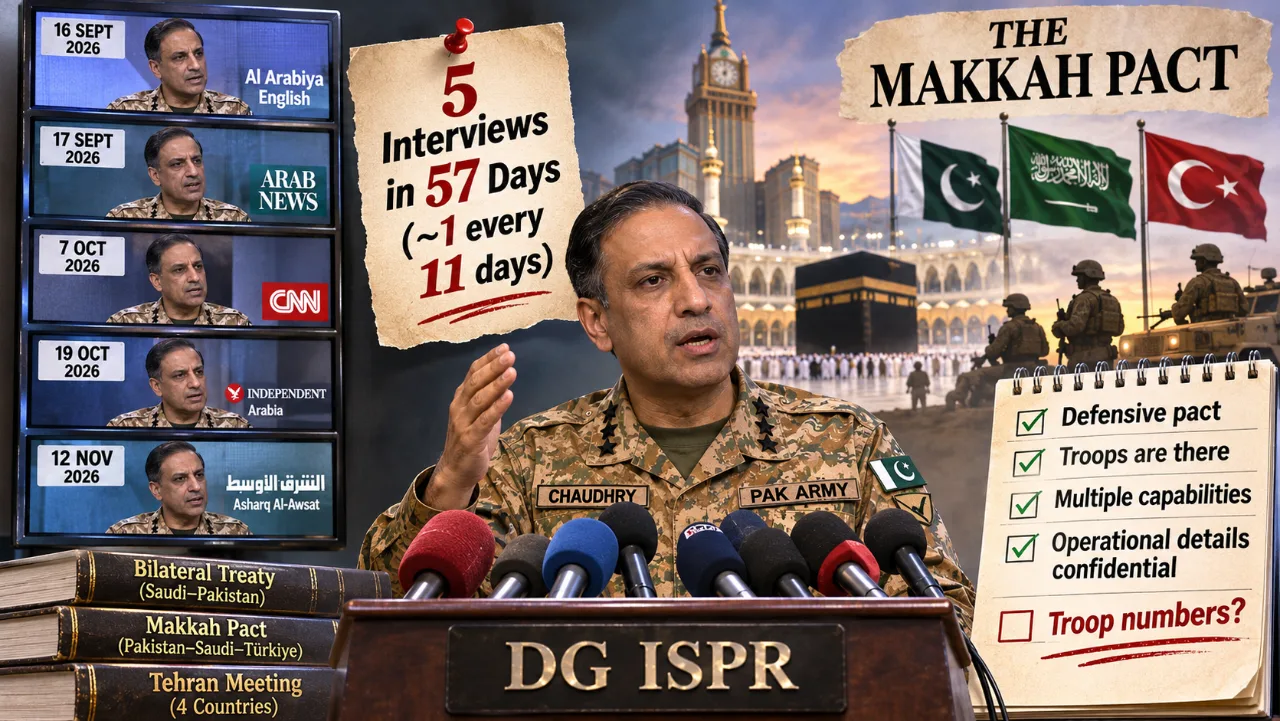
ISLAMABAD. The DG ISPR gave another interview today on 12 November 2026. This one is with Asharq Al-Awsat and Arab News Pakistan has the write-up, which says Lieutenant General Ahmed Sharif Chaudhry called the security of Saudi Arabia and the Two Holy Mosques a “top, non-negotiable priority.” I agree with every syllable. I also had the odd feeling I had read the sentence before and for a minute I suspected my newspaper of printing yesterday's edition. It hadn't. On 19 October Radio Pakistan ran almost the same line under the same word, from an interview with Independent Arabia.
Counting the microphones
Here is the run as I can rebuild it from press reports. Al Arabiya English on 16 September. Arab News the next day. CNN on 7 October. Independent Arabia on 19 October. Asharq Al-Awsat today on 12 November 2026. That is five interviews in 57 days, about one every eleven days, which is a lot of explaining for an agreement that, by its own spokesman's account, needs no explaining. If the Makkah Joint Defence Agreement were a restaurant it would have more reviews than tables.
What we have been told
The pact is defensive. It has no “regional aspirations,” in the words The News attributes to him in September. Troops are in Saudi Arabia, have been for decades according to the CNN interview and are there in “multiple capabilities”. Operational details are confidential, which Arab News gave as a headline. And the Defence Minister, Khawaja Asif, has said Pakistan would be bound to protect Saudi Arabia whether or not there was an agreement, particularly if Makkah or Madinah were attacked.
So, the Kingdom now has a bilateral treaty from September last year, a trilateral one signed on 7 August and a minister who says the paperwork was optional anyway. That is a great deal of promise per soldier and nobody will say how many soldiers.
Practical implementation
Today's interview adds that the alliance has moved to practical implementation after recent attacks on the Kingdom. Pakistani troops are already there, Chaudhry said, mainly in defensive support, exercises and manoeuvres and Islamabad is ready with military personnel, capabilities, training and logistical help. Arab News says the Houthis, whom it describes as Iran-aligned, have been sending drones and missiles at Saudi energy, aviation and civilian sites and that Saudi Civil Defense reported two ballistic missiles destroyed over Makkah on Thursday.
I take “practical implementation” to mean that until this week the arrangement was being implemented impractically. It would explain the interviews.
The report, gives no troop figure, no location and no chain of command. The DG has said before that operational details are decided by the three capitals and not normally published. It is a respectable position. It still leaves the citizen who hears “already there” feeling like a man said that dinner is already in the oven, in a kitchen he may not enter.
Four chairs
On 26 October, seventeen days before the interview, representatives of the Makkah alliance met Iran in Tehran. Field Marshal Asim Munir attended and had visited Tehran a few days earlier. The aim, in Chaudhry's account, was a framework for de-escalation and more regional cooperation. The four countries agreed to keep talking and the report says no other specific agreements were disclosed.
A pact for three, then, with a table for four. I want to be careful here. The report's adjective for the Houthis is “Iran-aligned.” It does not say Tehran directs the strikes and neither will I. The DG also told Al Arabiya in September that the pact does not complicate Pakistan's position towards Iran and that Pakistan is mediating between Tehran and Washington. I am sure that is right. I only observe that a spokesman who has to say it in five interviews is being asked about it in five interviews.
The case for the defence
There is a sensible reading of all this and it deserves a hearing. A pact that talks to the other side is cheaper than a pact that fights it and Pakistan shares a long border with Iran that it would like to keep quiet. Chaudhry called the Tehran meeting a de-escalation effort and the report says Pakistan strongly condemned the strikes on airports, cities and civilian infrastructure as a direct threat to Saudi sovereignty. Reasonable people can hold a treaty in one hand and a telephone in the other.
I would settle for one figure. A rough one would do, with the usual note that it may change. Until somebody supplies it, I will go on reading the interviews and at the current rate of one every eleven days the next should land around 23 November.