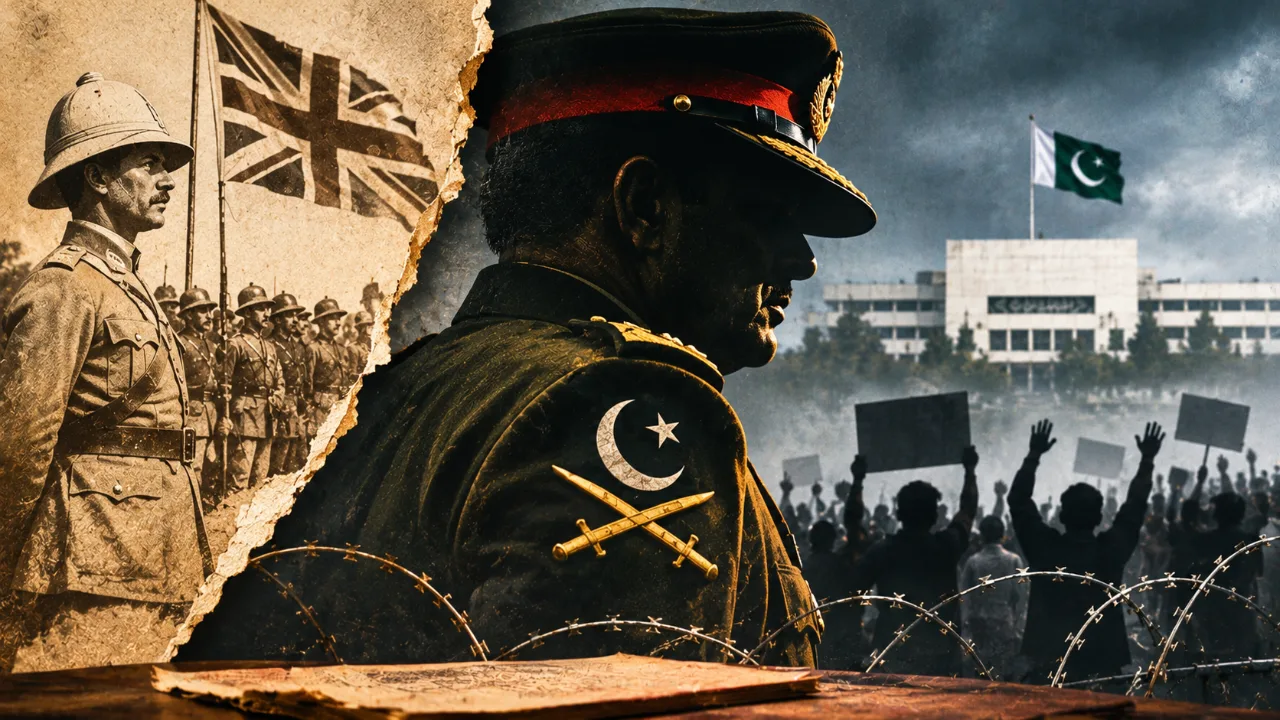
To make sense of why Pakistan’s military leadership clings so aggressively to political control, corporate assets and institutional dominance, one has to confront a basic structural reality: the armed forces never broke from their original colonial template. This was never a popular national defense force that slowly strayed into politics. It remains the direct institutional heir to a British imperial garrison executing the exact mission it was built for.
The Colonial Machinery
When the British reconstructed the Indian Army after the 1857 rebellion, they had no interest in building a democratic defence force. The institution existed for three specific tasks: policing native populations, securing tax extraction and fighting imperial expeditions abroad.
While post-1947 India pushed through constitutional ruptures to dismantle princely jurisdictions and establish clear parliamentary supremacy over the barracks, Pakistan imported the colonial machinery whole. Around four fifths of Pakistan’s early statutory architecture was lifted directly from the Government of India Act of 1935 and nineteenth-century colonial policing codes. When a state runs on imperial machinery, it reproduces imperial outcomes: citizens are treated as subjects to manage, not voters to answer to.
The British managed this by cultivating the myth of the "martial races", recruiting heavily from specific rural pockets of Punjab and the frontier while strictly stripping soldiers of any broader political consciousness. Recruits were trained to revere the commanding officer, the regiment, and the crown not republican ideals, civic rights or self-determination. While George Washington’s Continental Army mutinied against a distant king to establish a constitutional republic, the Raj’s native regiments were drilled to fire on their own neighbours whenever ordered.
The Conditioning Pipeline
That institutional culture still defines the Pakistan Military Academy at Kakul. Recruits arrive with ordinary political instincts, varied regional backgrounds, and personal worldviews. Within weeks of induction, that civic identity is systematically taken apart.
Intense physical exhaustion and rigid isolation replace personal moral agency with institutional tribalism. Cadets absorb a worldview that treats civilian politics as dirty, corrupt, and inherently suspect, while elevating the army as the sole custodian of the country’s borders and ideological boundaries. Life inside regimental centres and cantonments keeps officers sealed in a privileged social enclave, largely insulated from the economic hardships of ordinary Pakistani society.
Repression as an Instinct of Survival
For decades, the high command sustained this arrangement by wrapping itself in nationalist mythology, presenting the army as an indispensable shield against external destruction. That consensus is gone.
The establishment no longer enjoys the widespread public deference it once commanded; it faces broad, open hostility. Without genuine public consent, the high command has leaned entirely on force. While Pakistan has lived through direct military dictatorships under Ayub Khan, Yahya Khan, Zia-ul-Haq and Pervez Musharraf, the current campaign overseen by General Asim Munir operates with unprecedented, systematic severity.
Historically, Rawalpindi directed its harshest violence toward the periphery:
- East Bengal (1971): Scorched-earth tactics, systemic brutality, and mass killings that ended in the breakup of the country.
- Balochistan: Decades of enforced disappearances, extrajudicial killings and militarized resource extraction.
- Khyber Pakhtunkhwa: Sweeping military sweeps, civilian displacement and collective punishment.
- Sindh: Decades of political engineering and kinetic policing in urban centres.
What sets the present crackdown apart is geography. For the first time, the military machine has turned inward against its traditional recruitment heartland: Punjab. Midnight raids on political organizers, digital blackouts and the wholesale suspension of legal protections in Lahore, Rawalpindi, and Faisalabad reveal an institution actively devouring its own base of support.
The Mechanics of Internal Fracture
Dictators and overreaching army chiefs in Pakistan rarely step down because of civilian petitions or street protests. They fall when the generals around them conclude that one man's overreach threatens the survival of the military corporation itself.
Real executive leverage inside Rawalpindi sits with three offices:
- The Director-General of Inter-Services Intelligence (DG ISI)
- The Chief of General Staff (CGS)
- The Commander of X Corps (Rawalpindi)
An army chief only loses his footing when the corps commanders decide that public outrage is beginning to jeopardize their corporate holdings, their families' security and the army's cohesion.
The real danger rests with junior officers the captains, majors and colonels ordered to enforce these measures on the ground. If public anger reaches a breaking point, senior generals have the means to retreat to fortified cantonments or overseas properties. The junior officer corps, whose own families feel the weight of soaring living costs and social collapse, will be left behind to face an alienated, angry public. Enforcing a colonial doctrine against one’s own population is no longer just unconstitutional; it is institutional suicide.