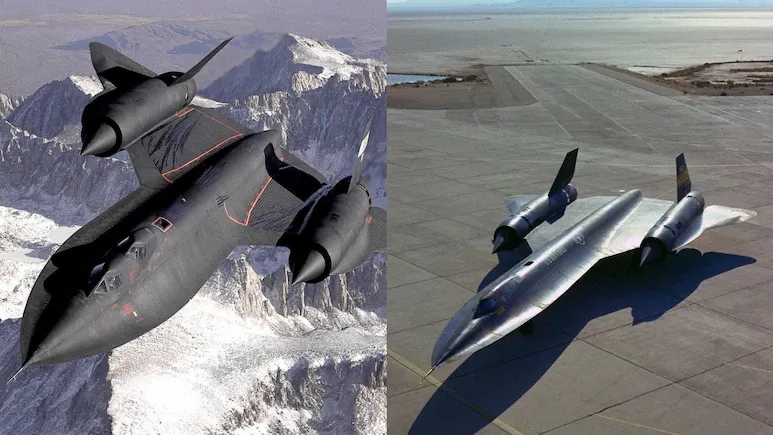
WASHINGTON — NASA has approached former engineers involved with the SR-71A Blackbird as the agency explores the possibility of returning one of the retired aircraft to flight nearly three decades after its last mission.
The aircraft at the centre of the reported effort is SR-71A Tail No. 844, which has been displayed at NASA’s Armstrong Flight Research Center at Edwards Air Force Base in California since its final flight in 1999. Satellite imagery obtained by Aviation Week shows that the aircraft was removed from its outdoor display and moved into a hangar previously used by the Space Shuttle.
NASA has not confirmed that it is preparing the aircraft for a return to the skies. A spokesperson told Aviation Week that the agency recognised the interest surrounding the SR-71 and its history with NASA but had no additional information to provide.
The reported preparations have nevertheless involved people with direct experience of the Blackbird. Mike Relja, a former US Air Force and NASA test engineer who worked with the aircraft, told Aviation Week that NASA contacted him about the project. Another former NASA SR-71 test engineer, Tim Conners, was also offered a role but declined it.
Relja said returning Tail No. 844 to operational condition would present substantial technical and logistical difficulties after almost 27 years without flying. The aircraft has spent decades exposed to the elements, while critical components and specialised support equipment required to operate the Blackbird are no longer readily available.
The SR-71 was designed to operate at extreme altitude and speed. Its two Pratt & Whitney J58 engines, specialised fuel system and unusual operating procedures were developed for an aircraft that could cruise at more than three times the speed of sound.
NASA operated several Blackbirds during the 1990s as research platforms, using them to study high-speed aerodynamics, propulsion, thermal protection, atmospheric conditions and other technologies. Tail No. 844 became the final SR-71 to fly when it conducted a research mission in October 1999. NASA’s own historical records identify the aircraft as having been used for a range of high-speed research experiments, including the Linear Aerospike SR-71 Experiment.
The long period of inactivity would make a return-to-flight programme considerably more complicated than simply restoring the aircraft’s airframe. Relja told Aviation Week that engines that have been stationary for decades would require extensive inspection and potentially major refurbishment. When the aircraft was operational, spare engines were routinely rotated and run to maintain readiness.
The supply chain presents another obstacle. Many specialised components and pieces of ground-support equipment needed to maintain and operate the SR-71 are no longer produced. A large stockpile of Blackbird spare parts was destroyed by the US government in 2007, further complicating any effort to restore an aircraft to flying condition.
The aircraft also depended on specialised materials, including JP-7 fuel and triethylborane, a chemical used to initiate the Blackbird’s engines. Specialised oils, hydraulic fluids and ground equipment were also part of the support infrastructure surrounding the aircraft.
Some potential sources of replacement components remain. Several SR-71s are preserved in museums in the United States and Britain, and some parts from those aircraft could theoretically assist a restoration effort. Whether museum aircraft could legally and practically provide usable components would depend on their condition and the requirements of any NASA programme.
The reported activity comes as NASA Administrator Jared Isaacman has been promoting a renewed emphasis on experimental aviation and high-speed research aircraft. Ea