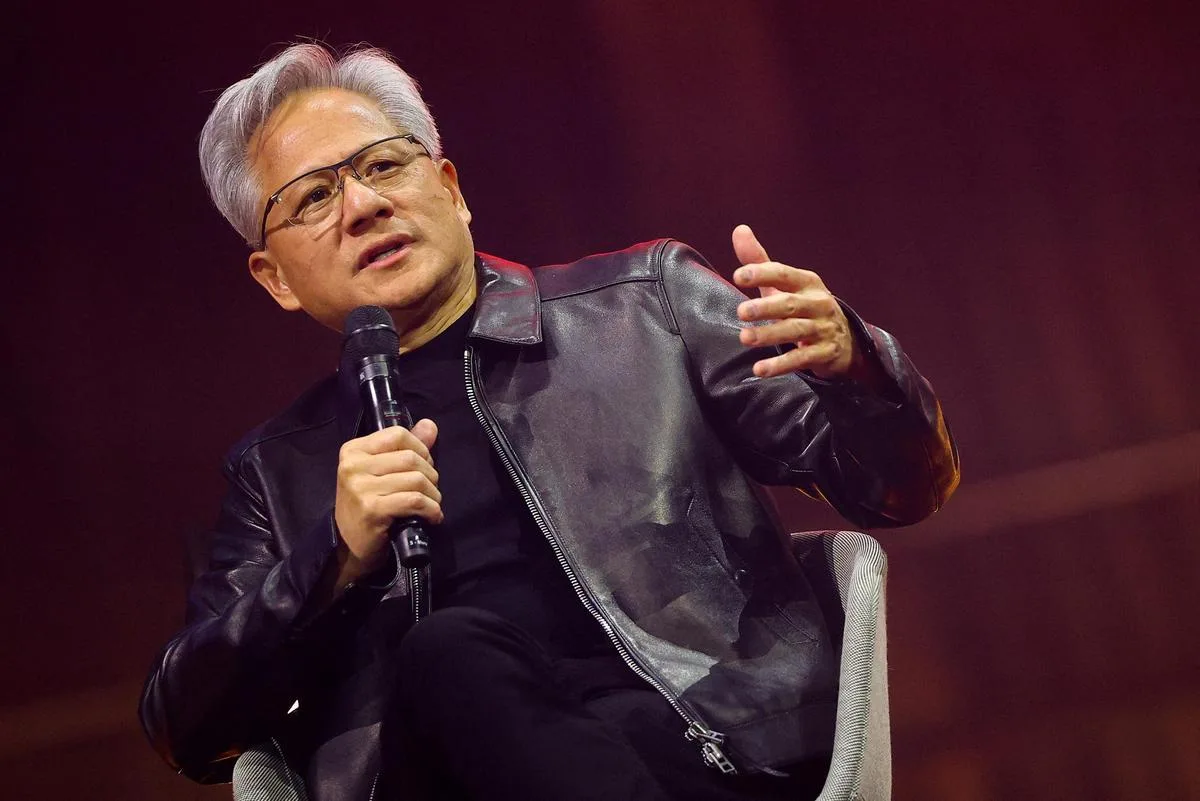
Nvidia's rise has become one of the defining stories of the artificial intelligence revolution. Its graphics processing units have transformed the economics of computing, powered the expansion of data centres and placed the company at the centre of a global contest over technological supremacy. Yet the controversy surrounding its chief executive, Jensen Huang, has exposed a vulnerability that extends beyond corporate governance. It raises a fundamental question for the United States: can a country maintain its technological advantage when so much strategic influence is concentrated in a single private company and its leadership?
Huang's journey from immigrant entrepreneur to one of the most influential figures in global technology is closely linked to Nvidia's transformation. Founded in 1993, the company initially built its reputation in graphics processing. Its decision to develop programmable GPUs eventually opened the way for applications far beyond gaming, particularly artificial intelligence and high-performance computing. Today, Nvidia's processors are essential to the infrastructure supporting the development and deployment of advanced AI systems.
This success has also made Nvidia strategically important to Washington. Advanced semiconductors are no longer simply commercial products. They underpin military research, intelligence processing, autonomous systems, cyber capabilities and advanced industrial applications. Control over access to computing power has consequently become a central element of the US-China technology competition.
That is where Huang's position becomes complicated. Nvidia's commercial interests are global, but the strategic interests of the United States are increasingly defined by competition with China. The company wants to retain access to important markets, protect its technological lead and prevent competitors from developing alternatives. Washington, meanwhile, wants to restrict China's access to computing capabilities that could strengthen its military and technological power.
These objectives do not always align.
Huang has repeatedly argued that excessive restrictions on semiconductor exports could accelerate China's domestic technology industry and weaken the position of American companies. His position reflects a commercial calculation: maintaining a presence in the Chinese market can preserve revenue, relationships and influence. But the national security argument is different. Even processors designed for commercial applications can contribute to capabilities with military and strategic uses.
The controversy surrounding reports of an alleged relationship between Huang and a woman suspected by US intelligence of having links to Chinese intelligence has brought this tension into sharper focus. Media investigations have raised questions about potential access to sensitive information and the possibility of foreign influence. Huang has acknowledged being unfaithful to his wife but has not publicly admitted any involvement in espionage. The wider allegations remain unproven, and there is no publicly established evidence that Nvidia's confidential information was compromised.
It is essential to distinguish between personal conduct, intelligence allegations and corporate wrongdoing. An alleged relationship does not establish an espionage operation. Nor does a reported intelligence assessment prove that sensitive information was transferred. The facts must be established through credible investigations rather than speculation.
Nevertheless, the controversy raises a legitimate national security concern. When a chief executive controls a company that sits at the centre of a country's strategic technology ecosystem, personal relationships and potential conflicts of interest can acquire consequences beyond the individual. Intelligence agencies do not necessarily need direct access to classified government systems to obtain valuable information. Insight into corporate strategy, commercial negotiations, export-control discussions and relationships with policymakers can itself carry strategic value.
This is particularly relevant because Nvidia's influence extends beyond the semiconductor market. Huang has become an important interlocutor in Washington's debate over technology policy. His views on export restrictions, artificial intelligence and the competitive position of American companies receive attention at the highest levels of government. That access is a reflection of Nvidia's importance, but it also demonstrates how much influence a private executive can exercise over issues with national security implications.
The wider commercial network surrounding advanced chips presents another challenge. Reports involving Singapore-based Megaspeed have raised questions about the movement of Nvidia processors through intermediaries and their possible availability to restricted Chinese customers. Such allegations illustrate the difficulty of enforcing export controls in a globalised technology industry.
A chip does not necessarily need to be physically transferred into China for its computing power to become accessible to Chinese users. Data centres located in third countries can provide remote access to processing capacity. Complex ownership arrangements, intermediaries and cloud services can make it difficult to establish who ultimately benefits from advanced computing resources.
This exposes a weakness in an export-control system focused primarily on the movement of physical hardware. Effective restrictions must also address end users, remote access, financing arrangements and the ownership of computing infrastructure. Without such scrutiny, restrictions can be undermined even when the hardware itself remains outside the prohibited destination.
For Washington, the challenge is to protect its technological advantage without undermining the companies responsible for creating it. Excessive restrictions could reduce American firms' access to global markets and create incentives for competitors to develop alternative technologies. Weak restrictions, on the other hand, could allow strategic rivals to acquire computing capabilities that strengthen their military and industrial systems.
The answer cannot be determined solely by the commercial interests of one company, however successful its chief executive may be. National security policy requires a broader assessment involving government agencies, legislators, intelligence institutions and independent technical experts.
The Nvidia controversy also exposes a deeper problem in the structure of America's technology leadership. The United States has relied heavily on private companies to develop critical technologies, often allowing commercial success to translate into considerable strategic influence. This model has produced extraordinary innovation, but it also creates dependencies.
When a company becomes indispensable to national technological ambitions, its governance and resilience become matters of public interest. Its board must be capable of exercising independent oversight, managing conflicts of interest and ensuring that the organisation does not become excessively dependent on one individual. The investigation initiated by Nvidia's board is therefore important not merely for resolving the immediate controversy but also for demonstrating that corporate accountability applies at the highest levels.
There is also a succession question. Huang's leadership has been central to Nvidia's identity and strategic direction. But technological dominance cannot rest indefinitely on the judgement and reputation of one executive. Nvidia must demonstrate that its institutional capabilities, research culture and management systems are strong enough to endure leadership transitions.
The issue is not whether Huang deserves recognition for building one of the world's most influential technology companies. His contribution is substantial. The issue is whether the company has developed governance structures proportionate to its strategic importance.
China's position adds another layer to the dilemma. Beijing is determined to reduce its dependence on American semiconductor technology and develop a more self-sufficient computing ecosystem. Restrictions on advanced Nvidia processors have reinforced that ambition. At the same time, access to American computing power remains valuable to Chinese technology companies. Washington's policy must therefore account for both the immediate risks of technology transfers and the longer-term consequences of accelerating China's domestic alternatives.
The controversy should also prompt a reassessment of what technological sovereignty means. Producing advanced chips is only one part of the equation. A country must also protect the intellectual property, software ecosystems, cloud infrastructure, supply chains and corporate decision-making processes that make those chips strategically valuable. The security of the entire ecosystem matters.
For America, Nvidia is simultaneously a symbol of technological leadership and a source of strategic dependence. Its success has strengthened the country's position in artificial intelligence, but the concentration of advanced computing capacity in a small number of companies creates vulnerabilities that cannot be ignored.
The final findings of the investigations into Huang, Megaspeed and the related export-control questions will determine whether specific corporate or national security breaches occurred. Until then, allegations must remain distinct from established facts.
But the larger lesson is already visible. The future of technological competition will not be decided only by who designs the fastest processor or builds the largest data centre. It will also depend on who controls access, protects sensitive information and maintains the institutional safeguards necessary to prevent commercial interests from undermining national security.
Nvidia's greatest achievement has been to make itself indispensable to the AI revolution. Its greatest challenge may now be proving that its strategic importance does not make it vulnerable. For Washington, the question is even larger: whether America's silicon advantage rests on a resilient national ecosystem or on the fortunes and decisions of a handful of corporate leaders.