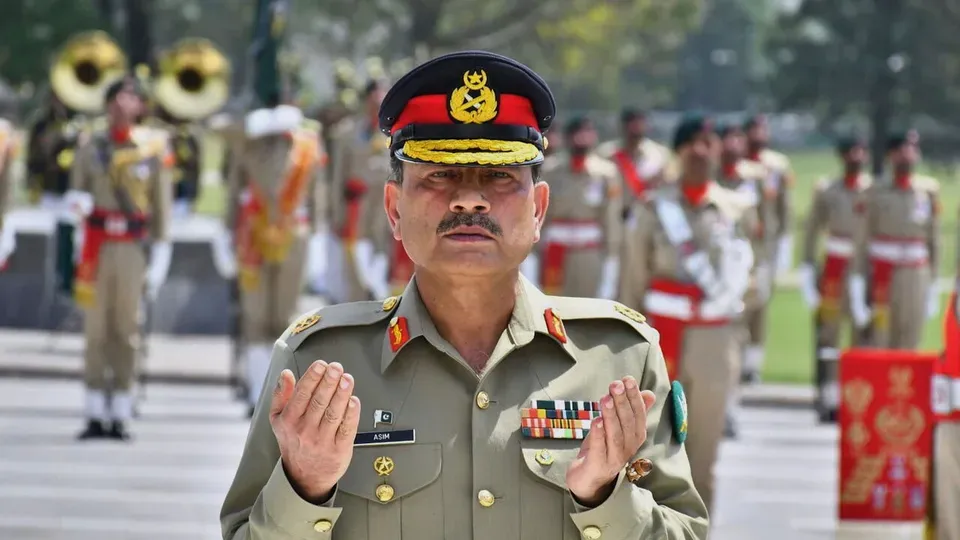
ISLAMABAD — Pakistan has fundamentally reorganised its senior military command for the first time since the 1970s, giving the country’s Chief of Defence Forces operational authority over the army, navy and air force in a system that places Field Marshal Asim Munir at its centre.
Parliament approved the Defence Forces of Pakistan Act, 2026, and amendments to the National Command Authority Act on August 20. The legislation gives statutory force to a new military hierarchy established through Pakistan’s 27th constitutional amendment last year.
The reforms abolish the post of Chairman of the Joint Chiefs of Staff Committee, or CJCSC, which had existed since 1976 as a coordinating position between Pakistan’s three military services. It is being replaced by a Defence Forces Headquarters headed by the CDF.
Munir currently occupies both positions of army chief and Chief of Defence Forces, making him the first officer to exercise the new powers across the entire military establishment.
Under the previous system, the chairman of the joint chiefs did not command the army, navy or air force. Each service remained responsible for its own operations, while the CJCSC provided a mechanism for coordination.
The new legislation establishes a direct command chain from the prime minister to the CDF and the Defence Forces Headquarters, followed by the individual service chiefs and military formations. The CDF is formally responsible to the federal government for operational command and control across the armed forces.
Retired military officials interviewed by Al Jazeera described the change as a fundamental difference from the former arrangement. Retired three-star general Naeem Khalid Lodhi said the new office had become a genuine command position rather than a coordinating role, while lawyer Abdul Moiz Jaferii argued that the old joint chiefs position had become largely symbolic because of the army’s dominance within the military hierarchy.
The restructuring follows Pakistan’s four-day conflict with India in May 2025 and comes as militaries increasingly organise operations around information-sharing and coordination across multiple domains.
Pakistan’s legislation seeks greater integration between land, air, maritime, cyber and strategic operations. The government has not publicly provided a detailed explanation of the reforms in the legislation beyond the broader objective of strengthening joint military capabilities, and the military’s media wing did not respond to Al Jazeera’s questions about the changes.
The most contentious issue is whether the new system has become too heavily weighted towards the army.
The commander of Pakistan’s National Strategic Command, the position responsible for the country’s nuclear-capable forces, must now come from the army and is appointed on the recommendation of the CDF. General Syed Aamer Raza became the first holder of the post in July after being promoted from lieutenant general.
Under the former CJCSC system, the top joint position could theoretically be held by an officer from any of the three services. The last non-army officer to serve as chairman was Air Chief Marshal Farooq Feroze Khan, who left the position in 1997.
That has prompted concern within parts of Pakistan’s defence establishment that the navy and air force could lose influence over senior appointments and strategic decision-making.
A former senior military official told Al Jazeera that the new system could eventually affect the separate institutional identities of the three services because senior appointments will be approved through the CDF. Retired vice admiral Ahmed Saeed warned that naval considerations could receive less weight in strategic planning if decisions become dominated by a land-focused military perspective.
Supporters of the reform argue that greater centralisation could produce faster and more coherent decisions during a military crisis. The old structure required coordination among separate services, while the new headquarters is intended to provide a unified command mechanism.
But centralisation also means that more authority is concentrated in a single office. That becomes particularly important because Munir is simultaneously the country’s army chief and CDF, rather than a separate officer appointed from outside the existing service commands.
The changes also intersect with Pakistan’s nuclear command system. The CDF is expected to serve as deputy chairman of the National Command Authority, which is chaired by the prime minister. The military has also established an Army Rocket Force Command for conventional missile operations that fall outside the nuclear chain of command.
The Strategic Plans Division, which has overseen Pakistan’s nuclear and missile programmes for more than two decades, is expected to continue its role under the new strategic command structure. Formal authority over Pakistan’s nuclear forces remains with the prime minister, although analysts cited by Al Jazeera believe the CDF could have a substantial influence over nuclear decision-making in practice.
The reforms have also raised constitutional questions.
Pakistan’s Constitution states that the federal government has control and command of the armed forces. Critics of the new legislation argue that giving the CDF operational command could weaken that civilian authority.
Former army officer and lawyer Colonel Inam Raheim said the new law transfers powers previously requiring involvement by the prime minister and cabinet directly to the CDF, including authority over the retirement, dismissal or continuation of military personnel.
Other legal experts dispute that interpretation. Supreme Court advocate Hafiz Ahsaan Ahmad Khokhar described the legislation as the statutory implementation of the constitutional framework established by last year’s amendment, rather than the creation of an authority outside the Constitution.
Pakistan’s political history gives the dispute added weight. The military has staged four coups since independence and has ruled the country directly for more than three decades. Even during periods of civilian government, the army has remained the country’s most influential institution on national security and foreign policy.
What distinguishes the current transformation is that the concentration of military authority is being formalised through constitutional and parliamentary measures rather than imposed through a military takeover.
The practical effect will depend on how the new headquarters operates and how much authority the navy and air force retain over their own affairs. Rules governing the new structure have yet to be fully finalised, leaving some questions over how the CDF will exercise authority in areas traditionally controlled by individual service chiefs.
For Pakistan, the reform represents a shift from a system built around coordination among three services to one with a single operational centre. For Munir, it consolidates authority over the country’s largest military institution while extending his formal command across the entire armed forces.
The central question now is whether the new structure will deliver the faster, more integrated military decision-making its supporters envisage, or whether concentrating authority in an army chief who also serves as CDF will deepen the imbalance between Pakistan’s armed forces and its civilian institutions.