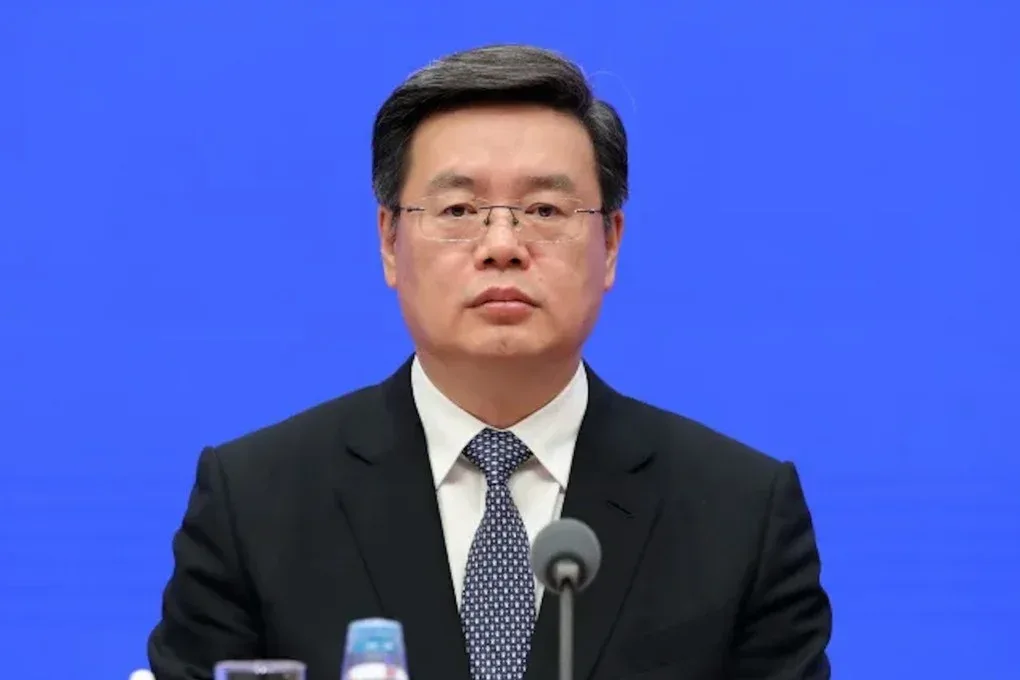
The sudden political collapse of former Shenzhen mayor Qin Weizhong has exposed once again the uncertainty surrounding China’s system of political discipline, where senior officials can move rapidly from positions of authority to the centre of a disciplinary investigation with little public explanation.
Qin resigned in August, officially citing a “change in work assignment”. Within weeks, the Central Commission for Discipline Inspection announced that he was under investigation for “serious violations of discipline and law”. The abrupt sequence has drawn attention to the opaque nature of China’s disciplinary system and to the vulnerability of officials whose careers depend heavily on political networks and the confidence of the Communist Party leadership. Qin Weizhong’s Fall Another Sig…
Qin’s career had followed a familiar path for China’s technocratic elite. After studying at Tsinghua University and working in the petrochemical sector, he entered government and rose through the Guangdong administration. He became vice governor of Guangdong in 2019 and mayor of Shenzhen in 2021, placing him in charge of one of China’s most economically important cities. A year later, he became an alternate member of the Communist Party’s Central Committee.
That ascent ended with striking speed.
The official language surrounding his investigation provides little detail about the alleged violations. Such formulations are routinely used by Chinese disciplinary authorities, but the absence of specific public allegations leaves considerable uncertainty over the precise circumstances of an official’s downfall. The lack of transparency also makes it difficult for the public to distinguish between cases driven by corruption investigations and those involving broader political or factional considerations. Qin Weizhong’s Fall Another Sig…
Qin’s case has also drawn attention because of his political associations. His career overlapped with Ma Xingrui, the former Guangdong governor who was expelled from the Communist Party in July 2026 on corruption allegations. Qin’s educational background at Tsinghua University also placed him within a broader network associated with Chen Xi, the former head of the Party’s Organization Department.
Such relationships do not establish wrongdoing by Qin or demonstrate that his investigation was politically motivated. They do, however, illustrate the importance of networks within China’s political system, where senior appointments and advancement are closely connected to party personnel structures.
The latest investigation comes against the backdrop of a much wider purge of senior officials. In recent months, China has removed prominent military figures including Zhang Youxia and Liu Zhenli, while Ma Xingrui was expelled from the Party. The scale of the turnover has intensified debate over whether Beijing’s anti-corruption campaign is strengthening institutions or creating further uncertainty within them. Qin Weizhong’s Fall Another Sig…
For President Xi Jinping, the campaign is officially presented as an effort to enforce discipline and eliminate corruption. But repeated removals of senior officials have also concentrated political authority around the leadership and created an environment in which officials have strong incentives to avoid political risk.
That has consequences beyond individual careers.
A bureaucracy dependent on political confidence can become cautious when the costs of making an unpopular decision are uncertain. Officials may prioritise political conformity over experimentation, particularly in areas where policy failure can carry disciplinary consequences. In a city such as Shenzhen, whose development has long depended on administrative flexibility and economic experimentation, sudden leadership disruption can also raise questions about continuity in local governance. Qin Weizhong’s Fall Another Sig…
The central weakness of China’s disciplinary system is therefore not simply that officials are investigated. Fighting corruption is a legitimate function of any government. The problem is the limited transparency surrounding the process.
When charges remain broadly worded and investigations are conducted largely outside public scrutiny, citizens have few independent means of assessing the evidence or understanding why one official is targeted while another is not. The Communist Party’s control over information further limits public debate over individual cases.
That opacity can produce the opposite of the institutional confidence that an anti-corruption campaign is intended to create. Instead of demonstrating that rules are applied consistently, opaque investigations can reinforce the perception that political survival depends on relationships, loyalty and the preferences of those higher in the hierarchy.
Qin’s career illustrates the vulnerability inherent in such a system. He had accumulated the credentials expected of a rising technocrat: an elite education, experience in industry, senior provincial responsibilities and leadership of one of China’s most important cities. None provided a visible shield once the political system turned against him.
The broader lesson is not necessarily that every purge is politically motivated, nor that every official under investigation is innocent. The available material does not establish either conclusion. The more fundamental concern is that a system with limited judicial and political transparency makes such questions difficult to answer independently.
China has built enormous economic and administrative capacity over the past decades. But institutional strength depends not only on the ability to remove officials. It also depends on predictable rules, credible procedures and confidence that accountability is applied consistently.
Qin Weizhong’s fall therefore matters beyond Shenzhen. It is another example of how quickly political fortunes can change inside a system where the Communist Party retains decisive control over appointments, discipline and information. For China’s officials, the message is unmistakable: advancement can be rapid, but so can reversal.
The long-term cost of such uncertainty is harder to measure. But when political discipline operates with limited transparency, fear can become a substitute for institutional accountability—and loyalty can become more important than the independent judgement that effective governance requires.