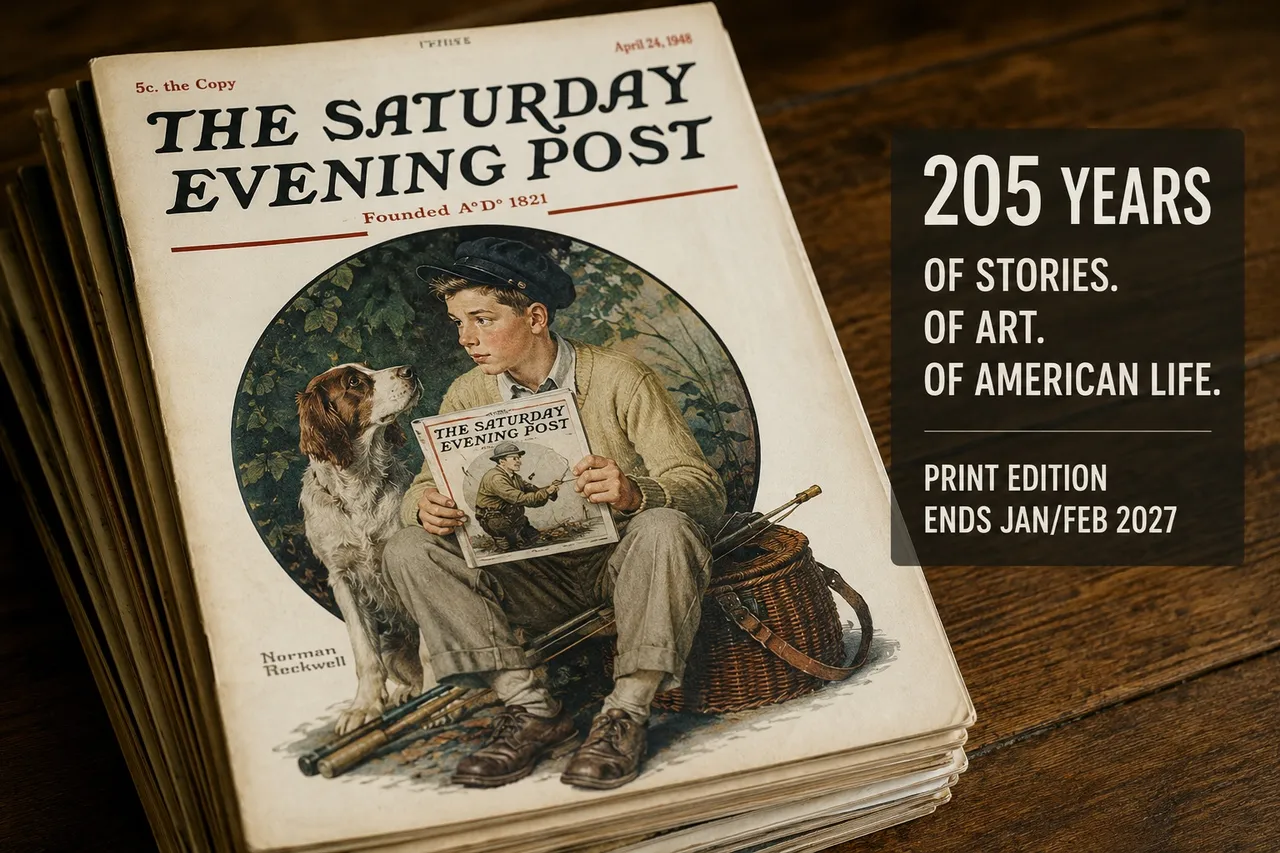
PHILADELPHIA — The Saturday Evening Post will stop publishing a print edition next year, ending a 205-year run for one of the United States’ best-known magazines while continuing to publish new material online.
The magazine’s January/February 2027 issue will be its final printed edition, publisher and president Joan SerVaas told subscribers in a letter included with the September issue. The decision was attributed to rising production costs, declining advertising revenue and changes in the way readers consume media.
The Post, first published in 1821, became a fixture of American popular culture through its fiction, journalism and artwork. It was particularly associated with Norman Rockwell, whose illustrations for the magazine helped define its visual image of mid-20th-century American life.
Its pages also carried works by prominent writers, including Jack London. Over more than two centuries, the publication evolved from a general-interest magazine into a title focused on American history, culture, health and other subjects.
SerVaas said the financial pressures behind the decision had been building for years. Advertising has increasingly moved away from print publications, while the magazine has struggled to attract younger readers, she told The Philadelphia Inquirer.
The Post will not disappear with the end of its physical edition. Its website will continue publishing articles and fiction, while its extensive archive of historic issues and artwork will remain available online.
The magazine’s history is closely tied to Philadelphia, where it began publication in the early 19th century. Its early issues were printed on a press associated with Benjamin Franklin, according to the Philadelphia Inquirer. The publication later became part of the publishing empire of Cyrus Curtis and operated for decades from the Curtis Building in Philadelphia.
The Post’s ownership changed hands in 1969, when Beurt SerVaas acquired the financially troubled magazine from the Curtis family and moved its operations to Indianapolis. His wife, Cory SerVaas, a journalist and physician, subsequently helped reshape the publication, including expanding its coverage of health and wellness.
Joan SerVaas, their daughter, now oversees the publication. The decision to end the print edition represents a further step in the long retreat of traditional magazine publishing, where higher printing and distribution costs have collided with declining advertising income and shifting audiences.
For the Post, the change comes despite the enduring value of its archive. Its covers, particularly those created by Rockwell and other leading illustrators, have become part of the visual record of 20th-century America and continue to attract collectors and museum audiences.
The publication’s final printed issue will arrive more than two centuries after its debut. Its transition to an online-only operation will allow the Saturday Evening Post to continue producing original journalism and fiction without the costs associated with printing and distributing a physical magazine.