WASHINGTON, September 24, 2026 — The United States and China have agreed to extend a fragile trade truce until January 10, buying the two governments two additional months to negotiate a broader economic agreement as Chinese President Xi Jinping began a rare visit to Washington.
US Treasury Secretary Scott Bessent announced the extension after meeting Chinese Vice Premier He Lifeng in Washington on Wednesday. The arrangement will maintain a pause on the most damaging tariff measures and prevent the immediate introduction of new trade restrictions, easing the risk of another sharp escalation between the world’s two largest economies.
The existing agreement had been due to expire on November 10. Bessent said the new deadline would give negotiators time to address unresolved issues during upcoming international meetings in China in November and Florida in December.
“I don’t know whether a bigger deal can be done. I don’t know whether we will just roll the current deal,” Bessent said in a television interview. He indicated that possible announcements during Xi’s visit could include financial-services arrangements and new Chinese purchases of American agricultural products.
The two sides have referred to the temporary arrangement as the Busan Agreement, after last year’s meeting between President Donald Trump and Xi in South Korea. That deal rolled back some restrictions on critical minerals and high-technology exports and suspended a tariff confrontation in which duties on goods from both countries had risen above 100 per cent.
The truce has reduced immediate pressure on global supply chains, but it has not resolved the broader strategic rivalry between Washington and Beijing. Disputes remain over advanced technology, artificial intelligence, rare-earth minerals, Taiwan and China’s trade relationship with countries involved in conflicts opposed by the United States.
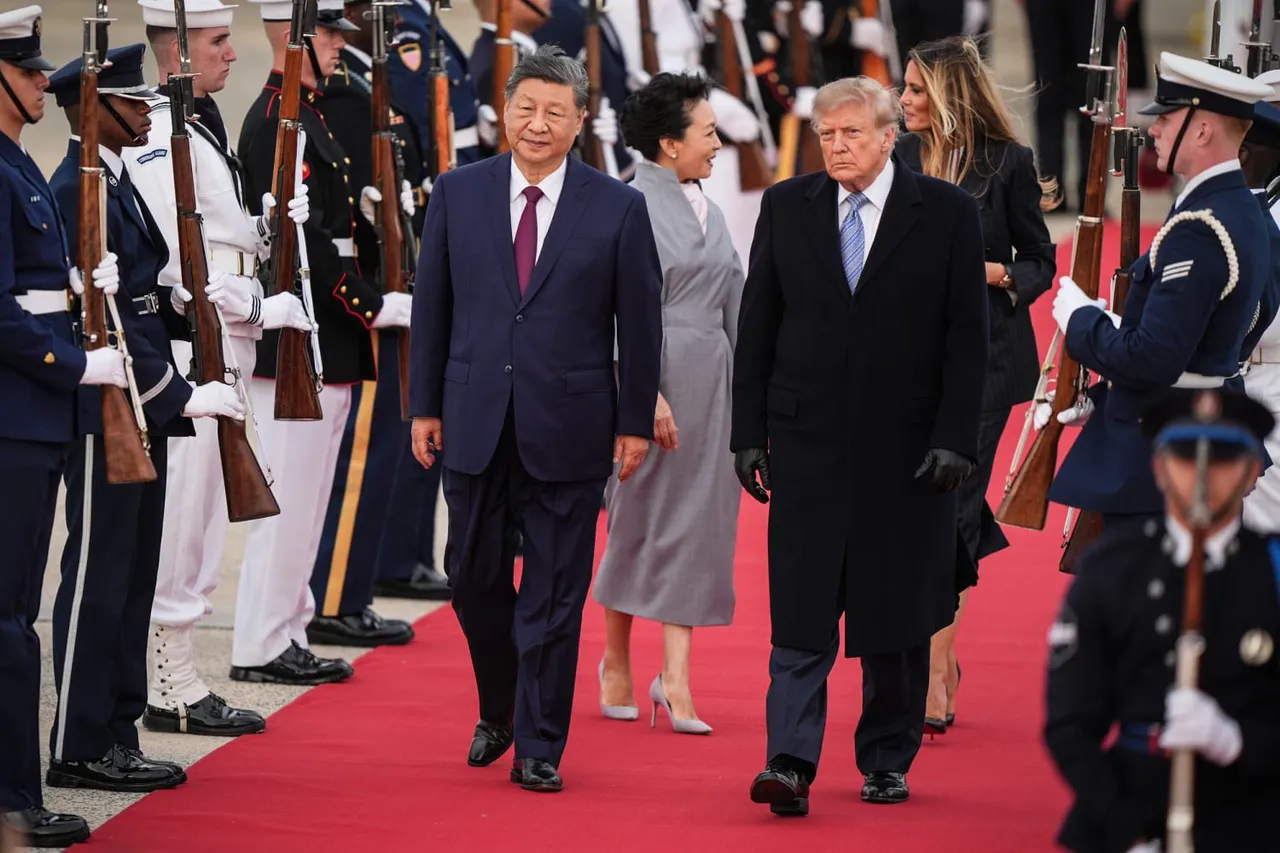
Xi arrived at Joint Base Andrews outside Washington on Wednesday for a three-day state visit. Trump personally met him at the airport, a rare gesture that reflected the importance both governments attach to stabilising relations.
The arrival ceremony featured a long red carpet, an honour guard, military bands, national anthems and a flypast by two B-1 bombers. Trump and first lady Melania Trump greeted Xi and his wife, Peng Liyuan, near the aircraft before posing for photographs.
Trump later described Xi in highly favourable terms, calling him a great leader and referring to him as a friend. He said the Chinese delegation was made up of “tremendous people” after returning to the White House.
Xi’s written statement struck a conciliatory tone. He said China and the United States should be partners rather than rivals and argued that the development of China and the effort to make America stronger could proceed together.
The Chinese president is due to meet Trump at the White House, followed by a state dinner and a series of ceremonial engagements. His schedule also includes a military ceremony and a visit to the National Archives.
The talks are expected to go beyond tariffs. Artificial intelligence is emerging as a possible area for structured dialogue, even as the two countries compete for leadership in advanced computing, semiconductor technology and military applications of AI. Officials have also discussed mechanisms for communicating about serious security risks linked to artificial intelligence.
Taiwan is likely to remain one of the most difficult subjects. Beijing regards the self-governing island as part of China and opposes US arms sales to Taipei, while Washington maintains a longstanding security relationship with the island. A major American arms package approved earlier this year has added to the tension.
The war involving Iran is another issue expected to arise. Washington has sought greater Chinese influence over Tehran, while Beijing’s broader economic and diplomatic engagement across the region remains a point of concern for the Trump administration.
The short extension of the trade truce highlights the limits of the current understanding. Rather than settling the dispute, it establishes another deadline and keeps negotiations alive while both governments test whether cooperation can be expanded.
For businesses, the agreement offers temporary predictability but little certainty beyond the beginning of next year. Companies continue to plan around the possibility that tariffs, export controls or restrictions on critical minerals could return if the talks fail.
The immediate priority for Washington and Beijing is to prevent the trade dispute from destabilising the wider relationship. The arrival ceremony and the extension of the truce present an image of cooperation, but the central disagreements between the two countries remain unresolved.