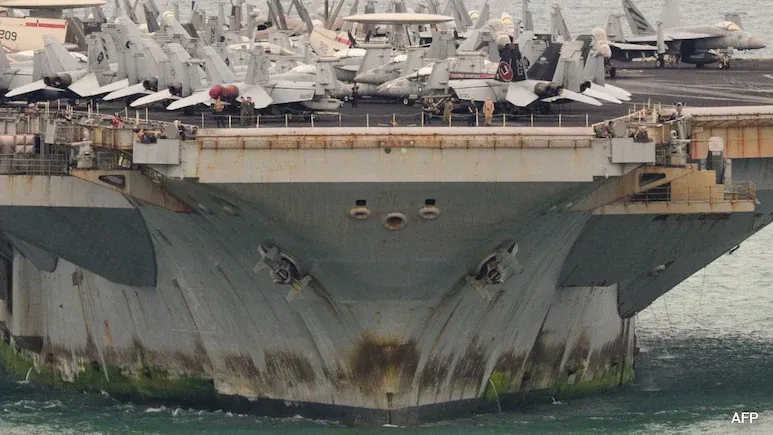
WASHINGTON, September 24, 2026 — Eight US service members attempted suicide during the extended deployment of the USS Abraham Lincoln carrier strike group, the acting Navy secretary has confirmed, disclosing the scale of a mental-health crisis that had already prompted concern among sailors’ families and lawmakers.
Acting Navy Secretary Hung Cao gave the figure in a letter to Democratic Senator Kirsten Gillibrand, who had requested information about conditions aboard the carrier and the welfare of its crew. The letter said there had been no deaths by suicide during the deployment.
The eight attempts involved personnel across the carrier strike group, including the Lincoln’s crew, its air wing, staff assigned to the strike group and destroyer squadrons, escorting ships and embarked aviation units.
Cao provided details of two incidents. In early August, a sailor assigned to the carrier’s air wing went overboard and was quickly recovered by a search-and-rescue helicopter. The sailor received treatment from the ship’s medical team and was later transferred elsewhere for further care. In March, another sailor tried to go overboard but was stopped by fellow crew members and eventually returned to the United States.
The disclosure followed months of reports about exhaustion, low morale, shortages and deteriorating living conditions during the carrier’s unusually long mission. Families of sailors had raised concerns about mental-health problems, food supplies, hygiene and the strain of spending extended periods at sea without regular port visits.
The Lincoln left California in November 2025 for what was initially expected to be a deployment in the South China Sea. It was redirected to the Middle East in January as tensions with Iran intensified. After US and Israeli attacks on Iran began in late February, the carrier supported combat operations and helped enforce a naval blockade of Iranian ports.
The carrier spent 286 days at sea before reaching Thailand in early September, with only one brief port stop during much of that period. The mission involved thousands of sailors and Marines and included sustained combat operations, air missions and heightened readiness against possible missile and drone attacks.
The prolonged deployment had already drawn criticism in Washington. In August, media reports cited family members who described low morale, exhaustion, poor hygiene and supply problems aboard the ship. Some families also said sailors had spoken of suicidal thoughts.
President Donald Trump dismissed earlier reports about the carrier’s conditions, calling them inaccurate. Defence Secretary Pete Hegseth likewise said the situation had been misrepresented. The administration maintained that the Navy had provided the crew with adequate support and that there was no evidence of a broader increase in suicide attempts.
Gillibrand said the Navy secretary’s letter contradicted those earlier dismissals. In a statement, she argued that concerns described as “fake news” had reflected serious and worsening conditions affecting military personnel.
The Navy has defended its response to the deployment. Cao said the carrier had access to a psychologist, behavioural-health technicians, a clinical social worker, a prevention counsellor, five chaplains and a facility dog. He also said sailors who attempted to harm themselves received immediate medical attention and follow-up care.
The letter acknowledged difficulties with resupply during major combat operations. Meal choices were reduced at times, while the Navy prioritised hygiene products, fresh provisions and critical repair parts. Cao also said plumbing problems had occurred earlier in the mission but had been repaired, and that the ship’s water supply was tested daily.
The Lincoln was relieved in the Middle East by the USS George Washington in late August and has since made stops in Thailand and Guam while travelling toward its home port in San Diego. Its exact return schedule remains classified.
The Navy has begun discussing changes to support future long deployments. Officials have said that additional storage for food, hygiene supplies and other essentials will be installed aboard the USS Theodore Roosevelt, which is expected to deploy to the Middle East in the coming weeks.
The revelation about the Lincoln comes as the US military continues to assess the costs of prolonged combat deployments. The Navy has said that its personnel remain committed to their mission, but the number of reported suicide attempts has intensified scrutiny of how much operational pressure crews can sustain without regular rest, maintenance and access to comprehensive mental-health care.