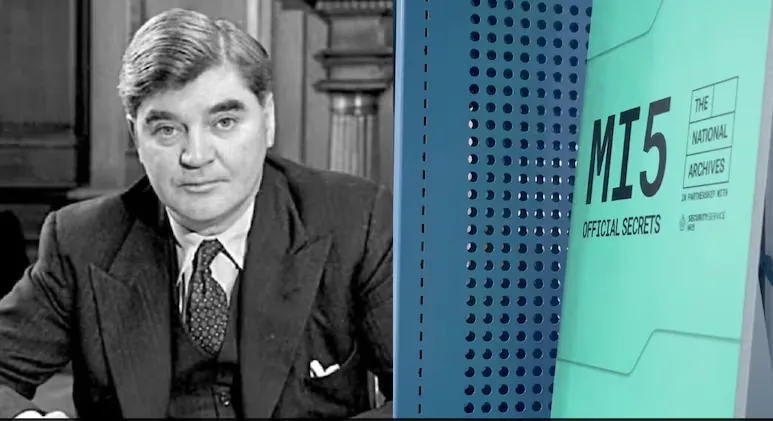
Britain’s newly declassified intelligence files have revived an uncomfortable question about the relationship between democracy and its security services. Aneurin “Nye” Bevan, the Labour politician who helped establish the National Health Service in 1948, was monitored by MI5 for decades because of his socialist politics, his associations with communists and his criticism of successive governments. Yet the investigations appear to have produced little evidence that he posed the security threat officials suspected.
The revelations, reported by Reuters following the release of files at Britain’s National Archives, offer more than an intriguing episode from the Cold War. They illustrate how easily political conviction can become a source of suspicion when intelligence agencies interpret ideological opposition through the prism of national security.
Bevan was no marginal figure. A former Welsh coal miner and forceful parliamentary orator, he became one of the most prominent voices on the British left. His campaign for a publicly funded health service helped reshape the relationship between the British state and its citizens. But before and after entering government, his radical politics and criticism of the establishment drew the attention of an agency concerned about communist influence.
MI5 opened a file on Bevan in 1933. Its surveillance continued through the Second World War and into the post-war period, even after he became a minister in Clement Attlee’s Labour government. The newly released records indicate that officials examined his parliamentary activities, movements, meetings and associations.
The irony is difficult to ignore. A politician who would become one of the architects of a defining British public institution was treated as a potential security concern partly because his political ideas challenged the prevailing order.
The files also reveal the limits of the case against him. A 1955 assessment noted that communist and Trotskyist groups had repeatedly attempted, without success, to recruit Bevan. After his death in 1960, an MI5 review described his file as remarkably uneventful given his controversial reputation. The file was not formally closed until 1975.
These details matter because intelligence surveillance is often justified by uncertainty. Agencies cannot always wait for a threat to become undeniable before investigating it. Foreign intelligence networks do seek access to political circles, and relationships with individuals linked to hostile states can warrant scrutiny. The existence of a surveillance file, therefore, does not automatically establish misconduct by the agency or innocence on the part of the subject.
But uncertainty also creates a danger. If political beliefs, public criticism and social associations are treated as sufficient indicators of subversion, the boundary between protecting the state and protecting those who govern it begins to blur.
Bevan’s case illustrates the distinction. His opposition to government policy was conducted openly in Parliament. According to reporting on the released records, some within MI5 questioned why his activities required intelligence attention when his speeches and political positions were already part of the public record. One official argued in 1943 that his activities were not a matter in which the security service should be involved.
That dissent within the agency is significant. It suggests that the problem was not simply the existence of surveillance, but the absence of a sufficiently clear threshold for deciding when political activity becomes a legitimate security concern.
The Cold War provides important context. Communist movements had international connections, the Soviet Union conducted espionage against Western governments, and Britain had reason to investigate genuine security breaches. But the existence of a real threat does not mean every person associated with the political left presents one. Nor does opposition to a government necessarily indicate sympathy for a foreign power.
This is a lesson that extends well beyond Britain’s post-war history. Democracies regularly face security threats that require intelligence agencies to operate with secrecy and discretion. The same secrecy, however, can make it difficult for citizens to distinguish necessary investigations from excessive monitoring. Individuals may not know they are under scrutiny, while the institutions conducting that scrutiny may face limited public pressure to justify their decisions.
The appropriate response is not to weaken intelligence services indiscriminately. It is to ensure that their powers are governed by clear rules, meaningful oversight and a distinction between evidence of hostile activity and the exercise of lawful political freedom. Intelligence assessments must be capable of being revised when initial suspicions are not substantiated. Surveillance should not continue indefinitely simply because a person’s views remain controversial.
The Bevan files also raise questions about institutional bias. Intelligence agencies, like other state institutions, operate within the assumptions of their time. During periods of ideological confrontation, those assumptions can shape which individuals attract attention and how ambiguous information is interpreted. Once a person is regarded as suspicious, ordinary meetings and political contacts may be viewed through that initial judgment.
This creates a risk of confirmation bias: evidence that supports suspicion receives attention, while evidence that contradicts it is discounted. The released records do not establish that every aspect of Bevan’s surveillance followed this pattern. They do, however, show why intelligence agencies need procedures that test assumptions rather than merely accumulate reports.
There is another reason the episode remains relevant. Bevan’s political legacy rests on his role in expanding the responsibilities of the British state towards its citizens. The NHS embodied the argument that access to healthcare should not depend solely on personal wealth. That vision emerged from a politician whose radicalism made him suspect to parts of the establishment.
It would be simplistic to suggest that surveillance alone defined the relationship between Bevan and the British state. His political career was shaped by fierce public debate, opposition within his own party and difficult policy choices. Yet the files expose a broader contradiction: democratic institutions can benefit from reformers while their security apparatus views those same reformers through a lens of ideological suspicion.
The value of declassification lies precisely in making such contradictions visible. Historical files allow the public to examine not only what intelligence agencies knew, but also what they believed, how they interpreted evidence and whether their attention was proportionate. They help distinguish genuine threats from the anxieties of an era.
The lesson is not that security agencies should never investigate prominent politicians. It is that political prominence, radical ideas and criticism of the government must not be treated as substitutes for evidence. A democracy has a legitimate interest in protecting itself from espionage, but it also has an interest in protecting the space in which citizens can challenge authority.
MI5’s long scrutiny of Nye Bevan ultimately raises a question that every democratic state must answer: can its security institutions defend the political system without confusing opposition to the government with hostility towards the country?
The answer depends on accountability as much as intelligence. A strong democracy does not demand that its security services ignore genuine threats. It demands that they identify those threats on evidence, recognise the limits of their authority and accept scrutiny when their judgments fall short. The state is not weakened when it protects dissent from unjustified suspicion. It is strengthened by the principle that disagreement, however radical, is not in itself disloyalty.