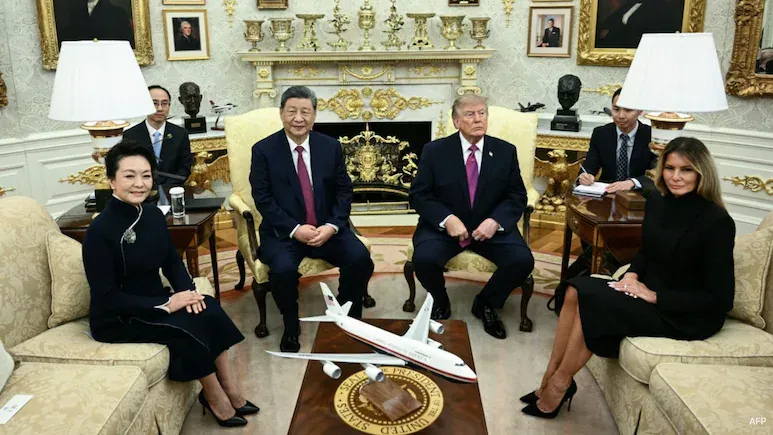
WASHINGTON, September 24, 2026 — Chinese President Xi Jinping said the United States and China had a responsibility to ensure that artificial intelligence was developed for beneficial purposes and remained under human control, placing the governance of advanced technology at the centre of his White House discussions with President Donald Trump.
“We have both the capability and responsibility to develop and manage AI for good and ensure that the development of AI is always under human control,” Xi said during opening remarks at the White House.
He did not specify what rules, safeguards or oversight mechanisms Beijing and Washington should adopt. Neither leader announced an agreement on artificial intelligence or outlined a joint framework during the initial remarks.
The exchange nevertheless highlighted the growing importance of AI in the relationship between the world’s two largest economies. Both countries are competing for leadership in advanced computing, semiconductor technology and increasingly capable AI systems, while also facing pressure to establish safeguards against misuse, accidents and loss of human oversight.
Trump had indicated before the meeting that artificial intelligence would be a major subject of discussion, but said he wanted to leave AI governance “exactly where it is”. In a message posted on Truth Social, he described “Super Intelligence” as a major topic and said the Justice Department would serve as the United States’ guardrail.
“That is China’s position also,” Trump wrote.
The two governments have not publicly agreed on what such a position would mean in practice. Their broader approaches to technology governance remain shaped by different political systems, regulatory traditions and national-security priorities.
US and Chinese finance officials met earlier in the week and discussed a possible mechanism for notifying each other about serious AI-related incidents. The proposal could provide a channel for communication if advanced systems produced dangerous results, were used in cyberattacks or generated risks with wider security implications. Details of the mechanism have not been announced.
The absence of a formal agreement underscored the gap between the two countries’ general language on responsible AI and the difficult negotiations required to translate it into binding rules. Questions remain over which systems would be covered, how incidents would be defined and whether either government would share information about technologies regarded as sensitive.
AI has become an increasingly contentious issue in national security, economic competition and public policy. Governments are examining its potential impact on military decision-making, critical infrastructure, employment, elections, surveillance and the spread of false information.
The White House meeting also came amid renewed debate about whether development of the most advanced AI systems should be slowed. Anthropic chief executive Dario Amodei has called for greater caution in the development of highly capable systems, and his concerns have received support from figures including OpenAI chief executive Sam Altman and Elon Musk.
China has criticised proposals for a slowdown, warning that alarmist arguments and confrontation between major powers could obstruct international efforts to govern the technology. Chinese Foreign Ministry spokesman Guo Jiakun said that fear-mongering and strategic rivalry would make global coordination more difficult.
The disagreement reflects a broader tension in AI policy. Some technology leaders and researchers argue that development is advancing faster than governments can assess the risks, while others warn that restrictive rules could damage innovation and allow one country to gain an economic or strategic advantage.
Washington and Beijing also differ over the role of the state, the regulation of private technology companies and the treatment of data and computing infrastructure. Any international arrangement would have to address those differences while also accounting for the security concerns of other major powers.
Xi’s remarks presented a broad principle rather than a negotiated policy: AI should serve human interests and remain subject to human authority. Trump’s position suggested that the United States is not seeking a new regulatory structure at this stage.
The two leaders’ discussion therefore produced common language on the need for responsible development, but no clear agreement on how human control would be maintained, who would enforce it or what limits should apply to the systems being built by both countries.