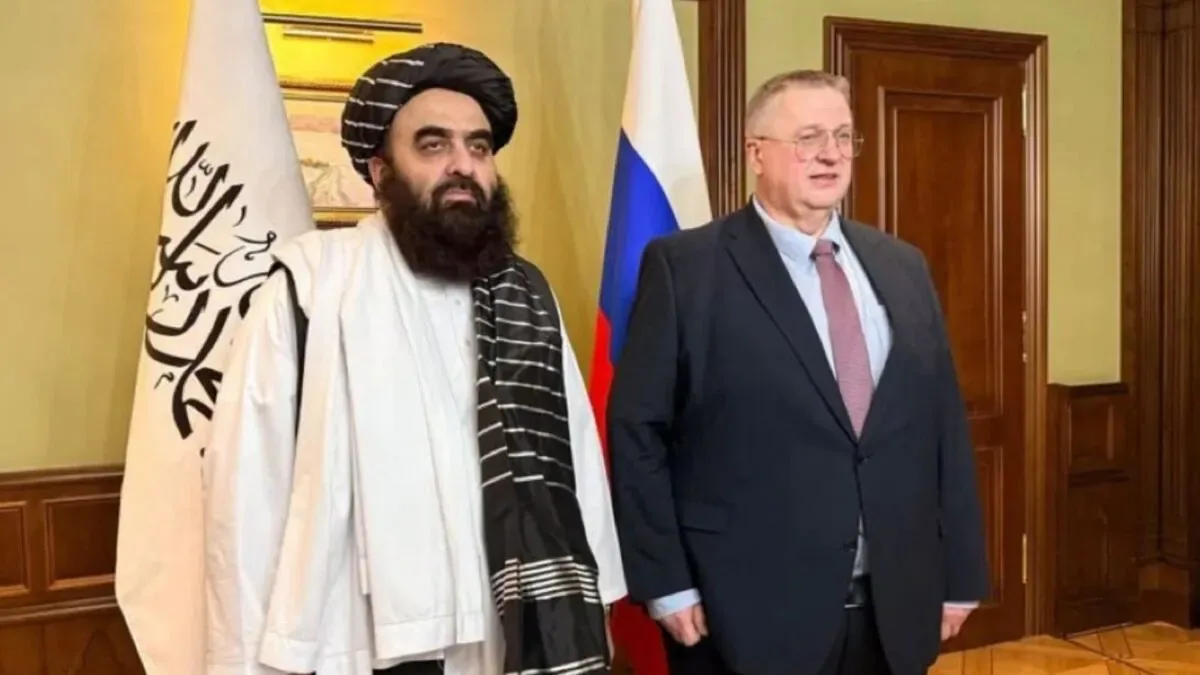
Russia used high-level talks in Moscow to reaffirm its political and security support for Afghanistan’s Taliban government, underscoring the deepening relationship between Moscow and Kabul as regional tensions surrounding Afghanistan continue to grow.
Russian Foreign Minister Sergey Lavrov welcomed Afghan Foreign Minister Amir Khan Muttaqi at the eighth Moscow Format consultations on Afghanistan on October 5. Lavrov praised what he described as the Taliban’s progress in combating terrorism and narcotics and linked those efforts to continuing military-technical cooperation between Russia and Afghanistan.
Lavrov also reiterated Moscow’s opposition to any future NATO military infrastructure in Afghanistan or neighbouring countries, arguing that such a presence would risk renewed instability and conflict. Russia has positioned itself as a key external power willing to engage directly with the Taliban since the group returned to power in August 2021.
The shift in Russia’s position has been particularly pronounced since Moscow became the first country to formally recognise the Taliban government in July 2025 after removing the group from its list of banned organisations. The move marked a further step in a relationship that had evolved from cautious engagement into increasingly open political and security cooperation.
The Moscow discussions brought together representatives from Afghanistan, Russia, India, China, Iran, Pakistan and Central Asian states, with Belarus and Egypt attending as guests. The agenda included political and economic cooperation, counterterrorism and counter-narcotics efforts.
But the meeting was overshadowed by the deteriorating relationship between Afghanistan and Pakistan. The two sides exchanged sharply worded accusations over cross-border attacks and militancy, highlighting the widening security dispute between the Taliban government and Islamabad.
Pakistan accused the Taliban authorities of allowing militant groups, including the Tehrik-e-Taliban Pakistan, to operate from Afghan territory. Pakistani envoy Mohammad Sadiq said terrorism remained at the centre of Afghanistan’s security problems and attributed thousands of Pakistani deaths to militant activity emanating from Afghanistan. Kabul rejected the accusations and condemned Pakistani military strikes, which it said had caused civilian casualties.
The disagreement was serious enough to prevent participants from issuing a joint statement after the meeting. Russian presidential envoy for Afghanistan Zamir Kabulov acknowledged that Afghan and Pakistani representatives had been unable to reach agreement on the final document.
Moscow nevertheless offered to help ease the confrontation. Kabulov said Russia was prepared to work independently or with other partners to help end the conflict if both sides requested assistance.
For Moscow, the Afghanistan question extends beyond relations with the Taliban. Russia is seeking to strengthen its influence across Central and South Asia while limiting the possibility of a renewed Western security presence close to its strategic neighbourhood. Its engagement with Kabul also reflects concerns over Islamic State-Khorasan, narcotics trafficking and the security consequences of instability spilling across Afghanistan’s borders.
At the same time, the Taliban continues to face substantial international isolation, particularly because of restrictions imposed on women and girls. Russia’s recognition and expanding engagement therefore give Kabul an important diplomatic opening even as most countries continue to stop short of full recognition.
The Moscow meeting consequently highlighted two parallel developments. Russia is becoming one of the Taliban’s most important international partners, while Afghanistan’s relationship with Pakistan is moving in the opposite direction.
That combination could make Moscow an increasingly important diplomatic venue for Afghanistan. But the failure to produce a joint statement also showed the limits of regional diplomacy when competing security interests between Kabul and Islamabad remain unresolved.