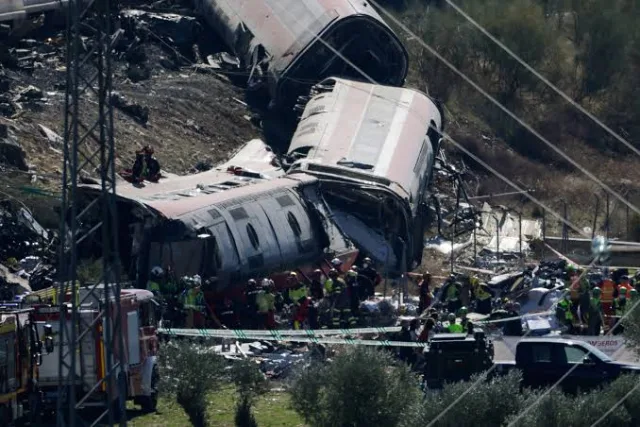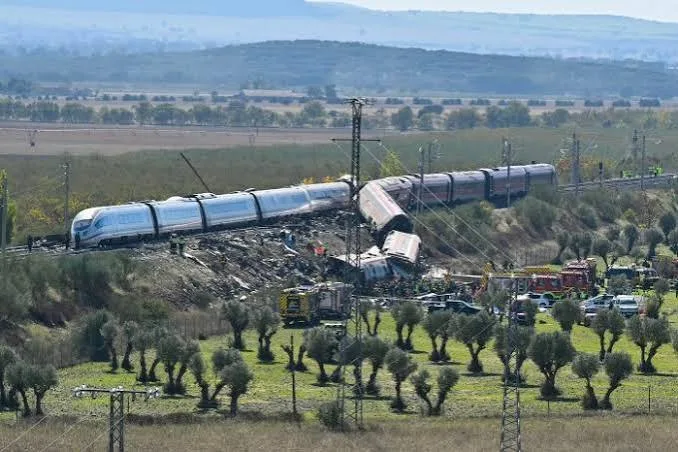
At least 68 people died on Wednesday 28 October when a high-speed train ran into the back of another that had stopped on the line between Madrid and Seville, in Toledo province. The regional government of Castilla-La Mancha gave the toll, and 58 more people were being treated in hospital. It is the deadliest rail disaster in Europe since the Santiago de Compostela crash of 2013, which killed 80 people, and the second major high-speed accident in Spain in nine months, involving the same two operators.
The state-run Renfe train, carrying 397 passengers, struck the rear of a stopped train run by the private operator Iryo, with 147 passengers, on a flat stretch of track between the towns of Urda and Los Yébenes. Both were heading south. The impact derailed the rear carriages of the Iryo train and the front carriages of the Renfe train. Regional officials said 24 of the dead were on the Renfe train and the rest on the Iryo train.
Transport Minister Óscar Puente gave a preliminary account. A computer fault in the safety system covering a 63-kilometre stretch of line stopped all trains in that section at about 8.30am. He said the traffic control centre then ordered the Renfe train to resume without speed restrictions, although a stop signal was still active and the train should at most have been told to proceed at reduced speed. It hit the stationary train at 8.53am, and he estimated it could have been travelling at around 200 km/h. He called the order inexplicable, said the drivers were not to blame and said he was not assigning responsibility to anyone. Investigators were still analysing data on the train's speed. Iryo said its train was struck from behind and that the cause was not yet known.
Rescuers searched the wreckage for survivors and bodies, concentrating on the two most badly damaged carriages. A military emergency brigade joined firefighters and police, medical helicopters flew out the injured, and a sports centre in Urda was turned into a triage point. Prime Minister Pedro Sánchez and King Felipe VI visited the site. Sánchez announced three days of national mourning and said two high-speed accidents in a year were unacceptable and that safety must be strengthened to restore confidence in the network.
The politics turned hostile quickly. Protesters, including far-right groups, gathered outside the Transport Ministry in Madrid demanding the government's resignation, and some clashed with police, who used tear gas. The Indian embassy in Madrid published emergency numbers for any Indians affected, and Australia's foreign ministry said it knew of no Australians involved.
The cause is still preliminary and the toll could rise. The first findings point to a failure of both the safety system and the human procedures that were supposed to cover for it.