Pakistan’s expanding air campaign inside Afghanistan is being presented by Islamabad as a security response to militant threats. But the frequency and timing of the strikes raise a broader question: is military action across the border becoming a substitute for confronting the pressures accumulating inside Pakistan?
Pakistan has repeatedly accused the Taliban government of allowing the Tehreek-e-Taliban Pakistan (TTP) to operate from Afghan territory. Kabul denies the accusation. The dispute has already produced repeated cross-border strikes, retaliatory fire and a steadily deteriorating relationship between two governments that were once closely aligned.
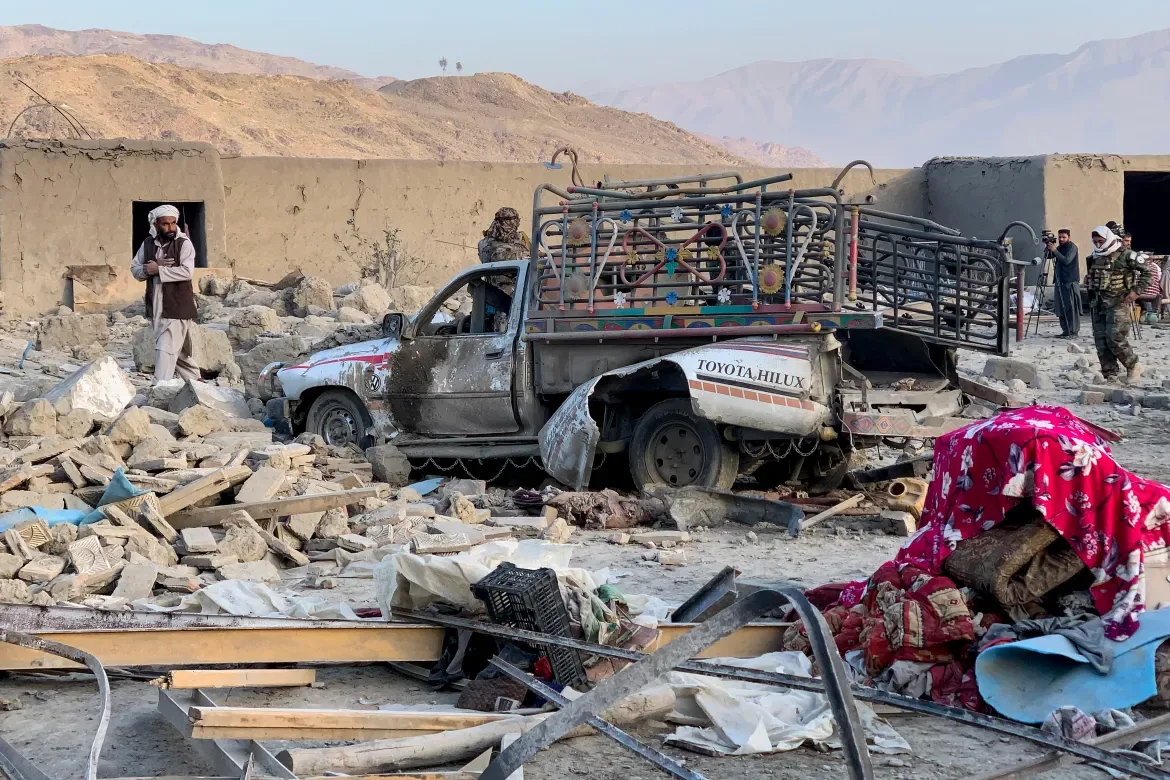
The latest escalation has followed a familiar pattern. Pakistan says its forces are targeting militant infrastructure and preventing attacks against its territory. Afghan authorities have disputed those claims and reported civilian casualties. In the October 1 strikes in Kunar and Helmand, Pakistan said it had destroyed militant positions and killed fighters, while Afghan authorities and the United Nations reported civilian deaths, including children.
The competing accounts matter. So does the larger pattern.
Pakistan is confronting a serious security problem of its own. Militant violence has increased sharply, with the TTP remaining a major threat and Baloch insurgent groups conducting increasingly sophisticated attacks. Independent assessments describe Pakistan’s security environment as highly volatile, with both domestic militancy and tensions along the Afghan border contributing to the deterioration.
That reality gives Islamabad a legitimate security concern. It does not, however, make airstrikes a substitute for a political strategy.
The danger is that repeated military action can create the appearance of control while leaving the underlying problem intact.
For Pakistan’s military establishment, Afghanistan offers an obvious external theatre. It provides a target that can be presented as responsible for insecurity at home. It also allows the government to frame domestic violence as an external problem rather than confronting the political, economic and security conditions that allow militant networks to survive.
That does not mean Pakistan’s allegations about militants operating from Afghanistan are necessarily fabricated. The TTP does maintain a presence in Afghanistan, and Islamabad has repeatedly linked attacks inside Pakistan to militants based across the border. Kabul’s denials have not resolved the dispute.
But the existence of a genuine security threat does not answer the larger question of strategy.
Airstrikes can destroy a facility. They can kill fighters. They can disrupt a planned operation. They cannot, by themselves, eliminate an insurgency whose networks operate across a porous frontier and draw strength from local grievances.
Indeed, civilian casualties can create precisely the conditions that militant organisations exploit.
Every cross-border strike that kills civilians gives armed groups another grievance to weaponise. Every family displaced by fighting becomes part of a broader pool of anger. Every confrontation that deepens hostility between Kabul and Islamabad makes intelligence cooperation and border management more difficult.
Military force can therefore become part of the problem it is intended to solve.
Pakistan has already experienced the limits of this cycle. Years of military operations against militant groups have repeatedly weakened individual organisations without producing a durable settlement to the political and security problems in the country’s frontier regions.
The Afghanistan question is even more complicated because Pakistan is dealing with a government it cannot simply intimidate into submission.
The Taliban controls Afghanistan. It has its own security interests, its own relationships with militant organisations and its own concerns about sovereignty. It is unlikely to accept Pakistan's demand that it unilaterally solve Islamabad’s TTP problem, particularly when Kabul itself accuses Pakistan of supporting or facilitating hostile groups.
The result is a classic security dilemma: each side describes its military actions as defensive, while the other interprets them as aggression.
And each new strike makes the next confrontation easier to justify.
There is another strategic calculation that deserves attention.
Pakistan is facing pressures beyond Afghanistan. Its internal security crisis is worsening, while Balochistan remains a persistent challenge. Pakistan also faces the demands of maintaining a wider regional security posture at a time when conflicts across the Middle East are placing new expectations on its military and diplomatic relationships.
Against that backdrop, Afghanistan can become the easiest front on which to demonstrate military activity.
That is where the language of deterrence can become politically convenient.
An airstrike is visible. A fighter aircraft crossing a border produces immediate headlines. It allows a government to demonstrate that it is responding to a threat.
Building functioning institutions in troubled regions, negotiating with political actors, improving border management and addressing grievances are slower and far less dramatic.
But they are also the measures that determine whether military gains last.
Pakistan therefore faces a choice that is larger than whether to conduct another airstrike.
It can continue treating Afghanistan primarily as a security problem and accept the risk of an expanding cycle of retaliation. Or it can treat the TTP issue as one component of a much broader regional problem requiring intelligence cooperation, border mechanisms, diplomacy and political engagement alongside targeted security operations.
The second approach would not guarantee success. The TTP remains a serious threat, and the Taliban government has yet to resolve the fundamental dispute with Islamabad over militant sanctuaries.
But the alternative carries its own danger.
If Afghanistan becomes Pakistan’s default answer to every major security crisis, Islamabad risks converting a difficult counterterrorism problem into a prolonged interstate conflict.
That would be strategically costly for both countries.
Pakistan cannot bomb its way out of its internal security crisis. Afghanistan cannot simply ignore the threat posed by militants operating from its territory. And neither government can indefinitely treat the other as the sole source of the region’s instability.
The central lesson is uncomfortable but straightforward: airstrikes can punish a threat. They cannot replace a strategy.
If Pakistan wants lasting security, the battlefield across the border cannot become a substitute for confronting the battles already taking place within its own borders.