For years, Pakistan has maintained a carefully calibrated relationship with Saudi Arabia. Riyadh has been a strategic partner, financial lifeline and important military customer, while Pakistani forces have trained and, at times, deployed to the kingdom.
But the latest crisis is testing whether that relationship can survive the difference between defending Saudi Arabia and fighting Saudi Arabia’s wars.
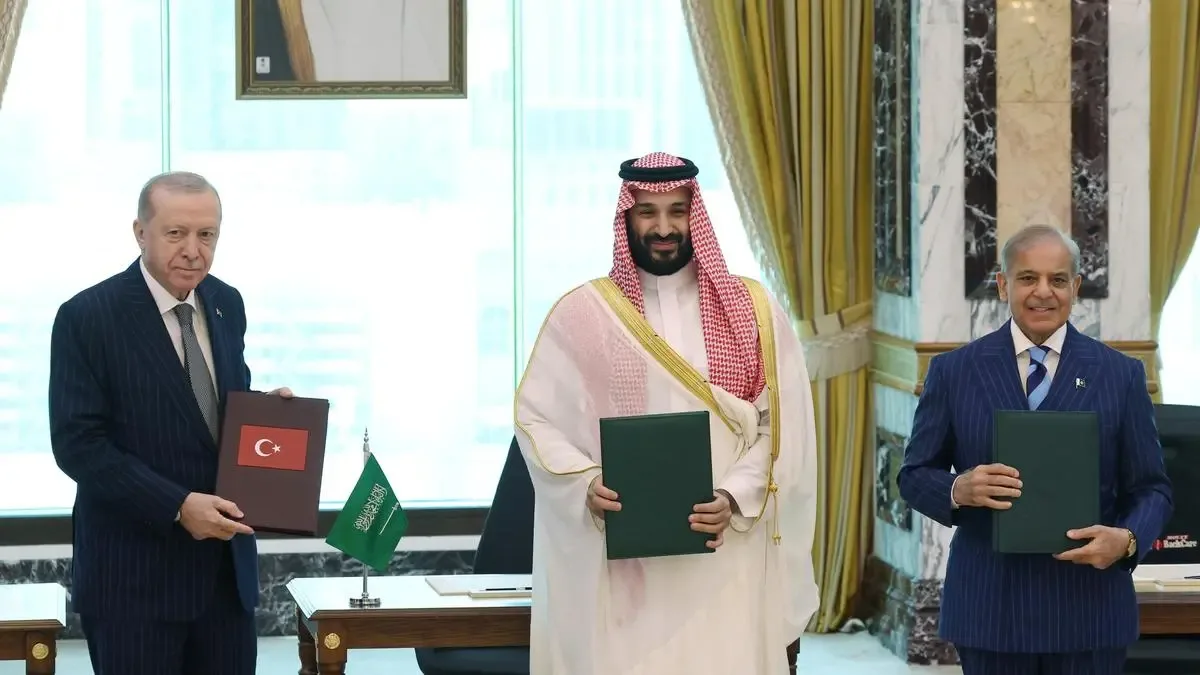
That distinction is becoming increasingly important as Houthi attacks push deeper into Saudi territory and bring the new Makkah Joint Defence Agreement closer to its first serious test. The agreement, signed by Saudi Arabia, Pakistan and Türkiye in August, states that an armed attack against one member will be regarded as an attack against all three.
On paper, that is a powerful declaration of collective security.
In practice, it leaves a crucial question unanswered: what exactly happens when Saudi Arabia is attacked?
Does Pakistan provide intelligence and air-defence assistance? Does it deploy troops to protect Saudi territory? Does it intercept missiles and drones? Or does collective defence eventually require Pakistani forces to strike targets in Yemen?
The difference between those options is enormous.
Pakistan has been here before.
In 2015, when Saudi Arabia assembled a coalition for its intervention in Yemen, Islamabad refused to join the war directly. Pakistan's parliament backed neutrality while making clear that the kingdom's territorial integrity would be defended if it came under attack. The distinction allowed Islamabad to preserve its relationship with Riyadh without entering a war against the Houthis.
The current circumstances are different because Pakistan has now signed a formal collective-defence agreement.
That makes the old ambiguity harder to maintain.
Saudi Arabia has obvious reasons for wanting Pakistan closer to its security architecture. The kingdom has spent years reassessing the reliability of external protection after episodes that exposed the limits of relying on a single security partner. Riyadh therefore has an interest in building additional regional capabilities rather than depending entirely on Washington.
Pakistan offers something different from the United States: a large standing military, long experience operating in the Gulf and an established defence relationship with Saudi Arabia.
But Islamabad also has reasons to hesitate.
Iran sits next door. Pakistan shares a long border with Iran and has repeatedly sought to maintain working relations with Tehran despite serious security disputes. A Pakistani military campaign against the Houthis would risk turning Saudi Arabia's conflict into Pakistan's confrontation with an Iranian-aligned movement.
That would be a very different proposition from defending Saudi airspace.
It would also complicate Pakistan's already crowded security agenda.
Pakistan is dealing with militant violence along its western frontier, particularly from the Tehreek-e-Taliban Pakistan, while tensions with Afghanistan remain high. Balochistan presents another persistent security challenge. Opening a new military front thousands of kilometres away would consume resources and create additional strategic exposure.
This is why the wording of the Saudi-Pakistani pact matters less than how its obligations are interpreted during a crisis.
Collective defence agreements are designed to create deterrence by convincing an adversary that an attack will trigger a wider response. But deterrence works only when the adversary believes the response will actually occur.
That creates a dilemma for Pakistan.
If Islamabad is deliberately vague about what it will do, it preserves room for manoeuvre but risks weakening the credibility of the pact. If it makes a clear military commitment, it may find itself locked into a conflict it has spent years trying to avoid.
The Houthis could therefore force Pakistan to choose between strategic ambiguity and alliance credibility.
There is also a wider regional calculation.
Saudi Arabia, Pakistan and Türkiye are not simply three countries signing another defence document. Each is trying to expand its strategic room in a Middle East where established security relationships are changing. The agreement is part of a broader effort by Riyadh to diversify its security partnerships.
For Pakistan, closer defence ties with Saudi Arabia also offer diplomatic and economic advantages.
But alliances are easiest to celebrate when they remain theoretical.
The real test begins when an ally calls.
If Saudi Arabia is struck again and asks Pakistan for air-defence systems, personnel or intelligence, Islamabad may be able to respond without crossing its traditional red line. If Riyadh asks Pakistani forces to conduct offensive operations against the Houthis, the calculation becomes much harder.
And if the conflict expands to involve Iran directly, the consequences could be far greater.
Pakistan would then have to balance its relationship with Saudi Arabia against geography, its own security interests and its longstanding effort to avoid being pulled into rival regional blocs.
That is why the most important question surrounding the Makkah pact is not whether Pakistan has promised to stand with Saudi Arabia.
It has.
The question is how far that promise extends.
A treaty can create an obligation. It cannot eliminate geography, domestic politics or strategic interests.
Pakistan may be willing to defend Saudi territory. It may be far less willing to fight a war in Yemen.
That distinction could soon become the defining test of the alliance.
The coming weeks will therefore reveal whether the Makkah pact is primarily a mechanism for deterrence or the beginning of a genuinely integrated military commitment.
For Islamabad, the danger is that Riyadh may eventually ask for precisely the commitment Pakistan has historically avoided.
Pakistan has spent decades keeping one foot in Saudi Arabia’s security camp and the other outside its wars. The new pact may leave it with far less room to keep both feet where they are.
Tighten the opening and sharpen the thesisReduce repetition around the central dilemma