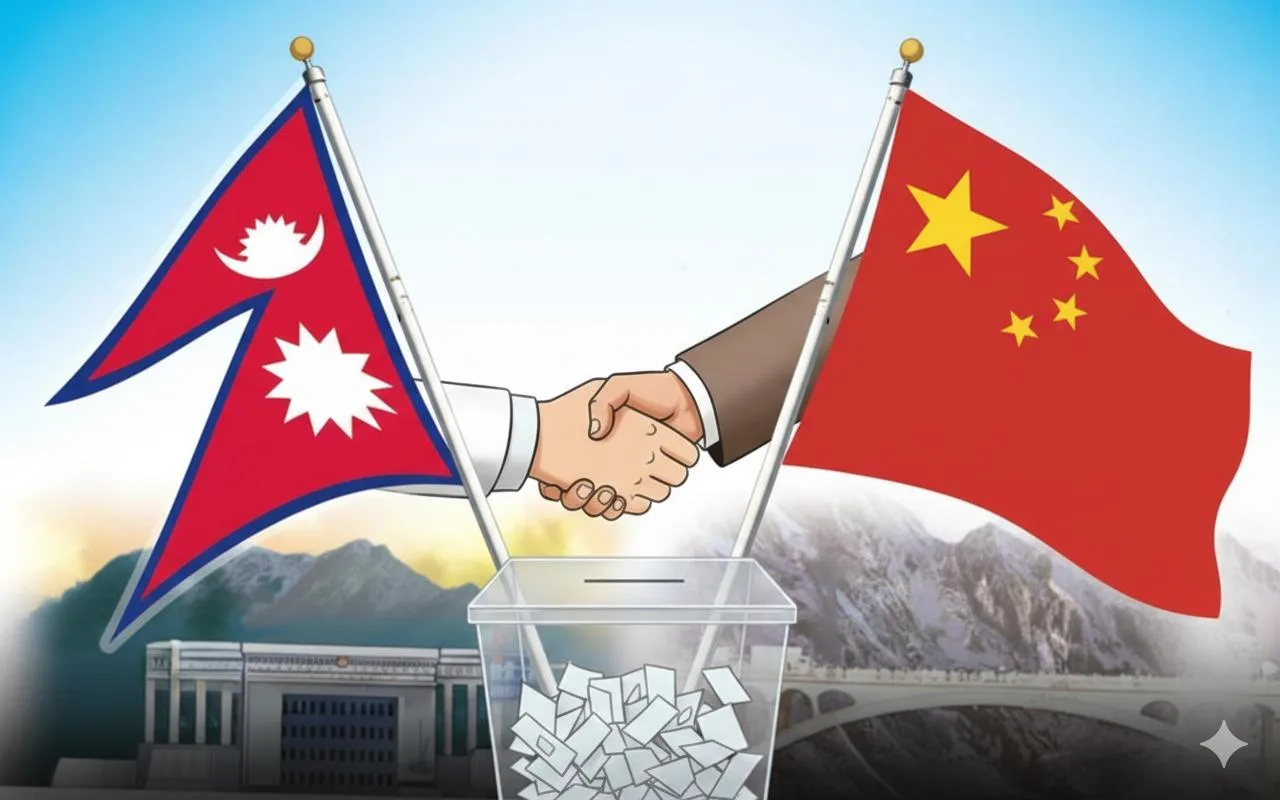
KATHMANDU — Nepal’s expanding military engagement with China is creating a new dimension in the security relationship between Kathmandu, Beijing and New Delhi, as Nepal seeks to deepen defence cooperation with its northern neighbour while maintaining its longstanding military ties with India.
Nepal Army Chief General Ashok Raj Sigdel’s visit to China from September 13 to 19 brought the evolving relationship into sharper focus. During the visit, Sigdel attended the 13th Beijing Xiangshan Forum, held talks with senior Chinese defence officials, including Defence Minister Admiral Dong Jun, and visited China’s National Defence University.
The discussions included future military cooperation and preparations for the next Sagarmatha Friendship exercise, the joint military drill involving the Nepal Army and the Chinese People’s Liberation Army.
For Nepal, the relationship with China offers practical areas of cooperation. Military education, disaster-response coordination and training suited to high-altitude environments are among the areas in which Kathmandu can benefit from closer engagement with the Chinese military.
The relationship, however, carries wider strategic implications because of Nepal’s geographical position between India and China. For New Delhi, the issue is less about any single military visit than about the possibility of sustained Chinese defence engagement gradually creating a deeper institutional relationship with Nepal’s armed forces.
China has expanded its defence diplomacy with Nepal through military training, exchanges between officers, equipment and other forms of assistance. Regular contact provides Beijing with opportunities to develop relationships within Nepal’s security establishment alongside its broader economic and political engagement with the country.
The Sagarmatha Friendship exercise is one of the most visible elements of that relationship. First held in 2017, the exercise has focused on areas including counter-terrorism, counter-insurgency, disaster response and operations in difficult terrain. Repeated exercises provide personnel from the two militaries with opportunities to work together and develop familiarity with each other’s procedures.
That interaction does not, by itself, indicate that Nepal is moving towards a formal military alignment with China. Kathmandu has traditionally sought to avoid being drawn completely into the strategic orbit of either of its two powerful neighbours. Its engagement with Beijing can therefore also be understood as part of a broader effort to maintain room for manoeuvre in its foreign and security policy.
China’s interest in Nepal also extends beyond conventional military cooperation. Tibet remains an important consideration in Beijing’s security calculations, particularly in relation to border management, intelligence concerns and the activities of Tibetan political groups and refugees. Closer security cooperation with Nepal consequently has significance beyond the military relationship itself.
For India, this makes Nepal’s defence engagement with China a matter that cannot be viewed separately from the wider Himalayan security environment. India and Nepal have maintained extensive military links for decades, including joint exercises, officer exchanges, training programmes and cooperation during disasters and other emergencies. The two countries also maintain the longstanding practice of conferring honorary military ranks on each other’s army chiefs.
The most prominent expression of the India-Nepal military relationship is the Surya Kiran exercise, which has provided the two armies with a regular platform for joint training and operational interaction.
Those established links remain important, but Nepal’s expanding defence contacts with China illustrate Kathmandu’s determination to maintain multiple strategic relationships rather than rely exclusively on one neighbour.
The Chinese relationship can also give Nepal additional diplomatic and strategic space as it manages its relations with both Beijing and New Delhi. For Kathmandu, maintaining that balance is particularly important because its economic, political and security interests are divided between two much larger neighbours with competing strategic priorities.
For Beijing, sustained defence engagement provides another channel through which it can strengthen its presence in a country of considerable geographic importance. For India, the development presents a reason to watch the trajectory of Nepal-China military cooperation closely, particularly if training, exercises, equipment transfers and institutional exchanges expand over time.
At present, there is no indication from the material available that Nepal and China are moving towards a formal military alliance or that China is establishing a military base in Nepal. The significance of General Sigdel’s visit lies instead in the gradual expansion of military-to-military contact between the two countries.
Nepal’s approach is likely to remain one of strategic balancing. Kathmandu has strong historical and institutional defence ties with India while simultaneously seeking closer cooperation with China. The challenge for Nepal will be maintaining that balance without allowing either relationship to undermine its stated preference for an independent foreign policy.
For India, the changing pattern of Nepal’s defence engagement with China represents a development to be monitored as part of the wider evolution of security relations across the Himalayas. The immediate issue is not whether Nepal has chosen between its two neighbours, but how far it can expand cooperation with China while preserving the military relationship and strategic confidence that have traditionally defined its ties with India.