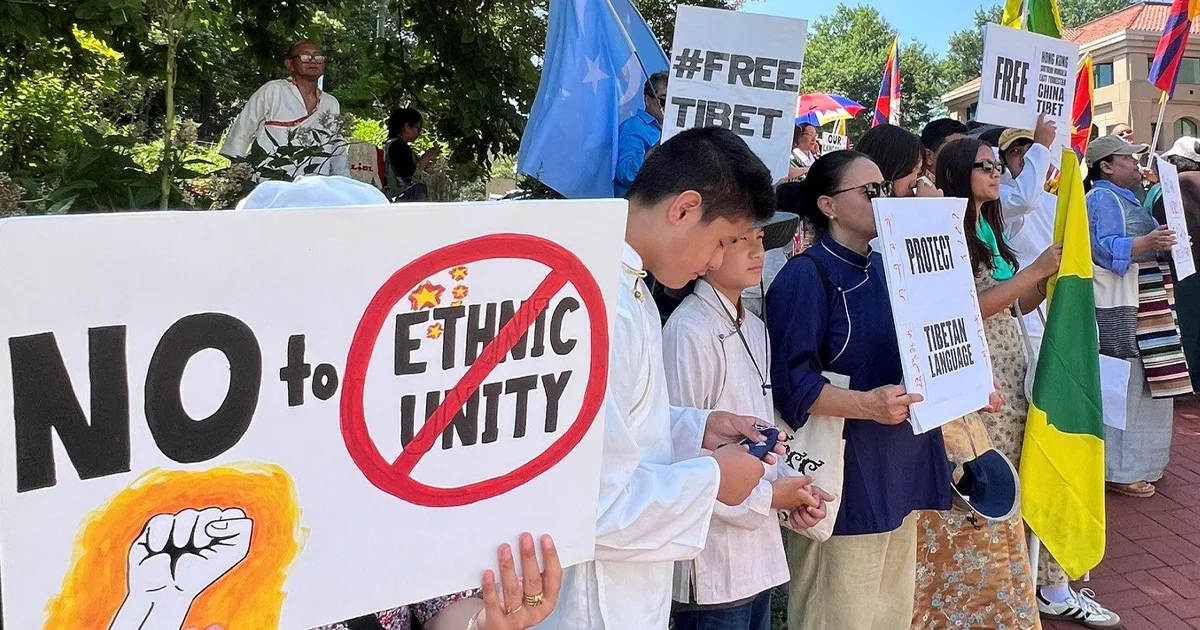
On Friday afternoon, Donald Trump walked Xi Jinping through the National Archives to look at the founding documents of American democracy. It was the closing image of a state visit heavy on ceremony: a twenty-one-gun salute, a flyover by two B-1 bombers, a state dinner, tea in the Red Room. A few streets away, some two hundred Uyghurs and several thousand other demonstrators had marched from the Chinese embassy toward Capitol Hill carrying Tibetan, Taiwanese and East Turkistani flags.
Between the founding documents and the pavement, one subject went unspoken. China's Law on Promoting Ethnic Unity and Progress - the statute that reaches directly into the lives of the people holding those flags - did not appear in the American readout, did not appear in Beijing's, and was not mentioned by either leader in public. Asked repeatedly whether he had raised human rights, Trump said the two had a great meeting.
The law was adopted by the National People's Congress on 12 March and took effect on 1 July. Sixty-five articles construct a single, Party-defined Chinese nation and subordinate the country's fifty-six official nationalities to it: Mandarin from pre-school, the "Sinicisation" of religion, and an obligation on parents, under Article 20, to raise their children to love the Communist Party. Article 31 forbids information that undermines "ethnic unity and progress." Article 58 punishes whoever undermines it. Neither term is defined anywhere in the statute.
Article 63 then extends liability for that undefined offence to organisations and individuals outside mainland Chinese territory. No conduct is enumerated. No court is named. No procedure attaches. And nothing in the text limits its reach to Chinese citizens.
This was not a subject nobody raised. Two days before the summit, Omer Kanat of the Uyghur Human Rights Project argued in The Diplomat that the law could not be left off the agenda, and framed it not as a human-rights appeal but as a question of American sovereignty: why are Uyghur Americans being forced to choose between exercising their freedoms at home and protecting their relatives in China? Senators Lindsey Graham and Sheldon Whitehouse had already written jointly to Ambassador Xie Feng, warning that any attempt to pressure US residents under Article 63 would be an unacceptable violation of American sovereignty. Congressman Jim McGovern put it more bluntly on the Capitol steps: no Xi in DC without human rights.
What the summit produced instead was a two-month extension of a tariff truce, warm words about artificial intelligence, and an agreement to meet twice more this year. Beijing's account of the talks did not mention human rights at all.
It would be easy to file this as one more instance of commercial interest crowding out principle. That reading misses what is specific about this law, and why the omission is not merely disappointing but operationally useful to Beijing.
The Ethnic Unity Law does not work the way ordinary criminal statutes work. No Chinese judgment will ever be executed against a resident of Rotterdam or Gothenburg, and Beijing knows it. The law works by being believed. Its enforcement runs through families: a sibling's passport, an exit ban on an ageing parent, a supervised video call from a police station in Kashgar. Three days after it came into force, three Uyghur women were detained in Urumqi for sending household goods to a sister's business in Turkey. There is rarely an incident to report, rarely a victim willing to be named, and never an offence a European prosecutor can charge. What there is, instead, is a slow thinning of testimony - fewer witnesses at hearings, fewer named sources, fewer scholars publishing under their own names.
A statute of that kind is weakened by attention and strengthened by silence. When the leader of the country that formally designated China's treatment of the Uyghurs a genocide sits across a table from Xi Jinping for three days and does not name it, the message reaching a family in Kashgar is not subtle. A law no leader is willing to name in the room is a law that is working.
Europeans reading this should resist the comfortable conclusion that Washington failed a test Europe would have passed. On 30 April the European Parliament condemned the law by 439 votes to 52, called for its repeal, urged member states to suspend extradition treaties with China and asked the Council to activate the EU Global Human Rights Sanctions Regime. Five months later the Council has produced no listing, no CFSP decision, no Foreign Affairs Council conclusions and no timetable for any of them. Europe has a resolution and a silence of its own.
The sovereignty framing is the one that should travel. Michel Harb and Arne Wackenhut of the University of Gothenburg, in a study of Uyghur activists in Sweden published in Ethnic and Racial Studies in February, concluded that transnational repression should be understood not only as criminal conduct requiring police attention but as a serious infringement of the host country's own sovereignty. That is the argument European interior ministries are actually equipped to act on. Switzerland has already reached the same place: its Federal Council's 2025 inquiry found that such pressure "poses a considerable threat to Switzerland's sovereignty in the long term."
Three things would cost Europe nothing and require no cooperation from Beijing. Criminalise coercion by proxy - most European criminal codes do not squarely capture the act of threatening someone's relative abroad in order to silence them at home, and this is the central protection gap. Instruct immigration authorities to refuse Interpol red notices grounded in ethnic-unity or splittist charges; the deportation of forty Uyghur men from Thailand in February 2025 is the precedent to prevent repeating. And place a joint legal rejection of Article 63 on the record at the Human Rights Council, alongside Taiwan, Japan, the Philippines and China's land neighbours - because a small state that objects alone is punished, while a small state that objects alongside twenty-seven others is merely one of twenty-eight.
In July, days after the law came into force, a Tibetan activist named Lobsang Palden set himself alight outside United Nations headquarters in New York and died of his burns. He was protesting against a statute that, ten weeks later, two of the most powerful men alive managed to spend three days together without mentioning.
The watcher does not need a warrant, because it does not need to arrest anyone. It only needs to be believed. Last week, it was helped.