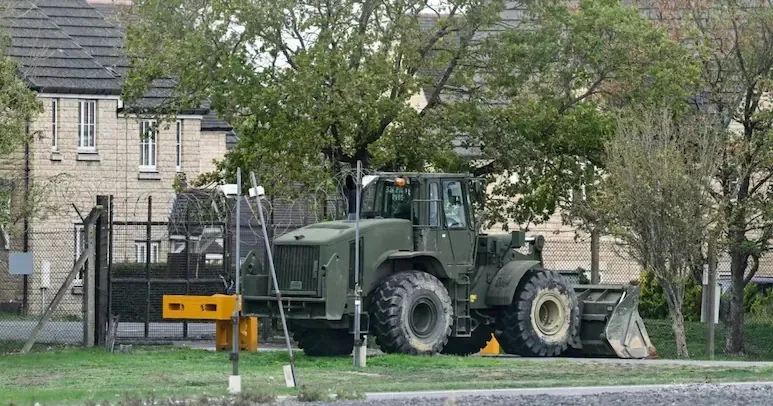
A suspected terrorism plot targeting RAF Fairford has triggered a major security investigation in Britain and prompted the United States to remove its bombers from the airbase, after authorities arrested several people near the facility.
The incident has also raised the possibility of an Iranian connection. British Prime Minister Andy Burnham has said there are “strong indications” that Iran played a role, while Tehran has denied any involvement. The investigation remains active and authorities have not publicly established what the suspects intended to do.
Five British men in their 20s were arrested shortly after midnight on September 27 after police received reports of suspicious vehicles near the Gloucestershire base. Three vans were searched and police found petrol, but no explosives. The suspects were subsequently released on bail and remain under investigation.
A sixth suspect, a British-Iranian dual national, was arrested in London several days later on suspicion of preparing a terrorist attack. He too was later released on bail.
British counterterrorism officials have said the decision to release the suspects does not mean the investigation has ended. Laurence Taylor, the head of Counter Terrorism Policing, said investigators were examining whether the suspected offences involved individuals acting independently or as proxies for a foreign state.
The precise nature of the alleged plot remains unclear.
A local farmer who alerted police reported seeing several people, some with their faces covered, near the airbase. Authorities subsequently evacuated nearby properties while searches were conducted. Police have not disclosed evidence establishing what the group planned to attack or how far the suspects had progressed in preparing an operation.
The investigation has nevertheless assumed wider strategic significance because of RAF Fairford's role in US military operations.
The British-owned facility, about 145 kilometres west of London, hosts the headquarters of the US Air Force's 501st Combat Support Wing and serves as a forward operating location for American heavy bombers. It has been used in major US military operations in the Middle East, including the Gulf War and the Iraq war. More recently, American bombers operating from Fairford have been involved in strikes against Iran.
Iran has previously warned that military bases used to conduct attacks against its territory could be considered legitimate targets. Tehran has nevertheless rejected accusations that it was involved in the Fairford incident and has criticised what it described as unfounded claims linking Iran to the investigation.
The United States responded by moving its heavy bombers out of Fairford.
American officials confirmed that the aircraft had returned to bases in the United States. President Donald Trump said the move followed a threat to the aircraft and that he did not want to leave them exposed. Vice President JD Vance described the decision as a precaution, while Secretary of State Marco Rubio characterised the movement of aircraft as part of normal military rotations and exercises.
The differing descriptions reflect the uncertainty surrounding the incident.
Trump and other US officials have linked the withdrawal to the security threat, while the Pentagon has not publicly disclosed the intelligence behind the decision. US officials cited by Reuters said concerns about a possible Iranian drone attack were among the reasons for relocating the bombers.
The withdrawal does not remove the United States' ability to conduct long-range strikes. B-1 bombers can operate from the continental United States with aerial refuelling, although basing them in Britain provides a shorter route to potential targets and reduces the distance involved in some missions.
For Britain, the incident presents a different challenge.
Fairford is both a British military installation and an important US operating location. Its use during the current conflict has made it a potential target in the wider confrontation with Iran, placing the security of a facility in rural Gloucestershire within the strategic calculations of a conflict taking place thousands of kilometres away.
It also raises questions about the growing use of proxies and locally recruited individuals in state-linked operations.
British counterterrorism authorities have previously warned about hostile-state activity on UK soil. The Fairford investigation is examining whether the suspects acted independently or were connected, knowingly or otherwise, to a foreign government. No such connection has yet been established in court.
For now, several critical questions remain unanswered: who organised the suspected operation, what its intended target was, whether the suspects had the capability to carry it out and whether Iran had any direct role.
The absence of explosives among the items seized has added to the uncertainty, but it has not ended the investigation.
What is already clear is the strategic consequence.
A suspected plot near a British airbase has led the United States to temporarily remove some of its most powerful aircraft from a key European operating location. Whether the incident ultimately proves to have been an Iranian-directed operation, an independent conspiracy or something less developed, it has demonstrated how quickly the wider Iran conflict can reach beyond the Middle East.
For RAF Fairford, the war is no longer simply something launched from its runways.
It has become a security problem at the gates.