As governments focus on trade, artificial intelligence, strategic competition and the risk of conflict, China’s human rights record risks becoming a secondary issue. That would be a mistake.
The political dissidents in prison, religious communities facing restrictions, activists denied political space and ethnic minorities subjected to sweeping state policies are not abstractions in a geopolitical contest. They are people whose rights remain at stake regardless of how important China becomes as an economic or strategic power. China’s Human Rights Crisis Has…
The temptation to compartmentalise the relationship with Beijing is understandable. China is too important to global trade, technology and security to be excluded from diplomatic engagement. Western governments and other major powers have strong incentives to maintain channels with President Xi Jinping’s government, particularly as competition intensifies and tensions rise over Taiwan.
But engagement does not require silence.
Human rights organisations and activists have for years documented concerns over political repression, restrictions on expression, surveillance and the suppression of independent civil society. Prisoners of conscience remain a central concern, particularly those who have advocated democratic reform, religious freedom or greater ethnic rights. China’s Human Rights Crisis Has…
The situation in Xinjiang has become one of the most serious international controversies surrounding China. Governments and human rights organisations have described the treatment of Uyghur Muslims in terms ranging from crimes against humanity to genocide. Reports of mass detention, forced labour, family separation and cultural assimilation have generated sustained international concern.
Beijing rejects such characterisations. But the persistence of allegations and the scale of international scrutiny mean the issue cannot simply be pushed aside whenever broader diplomatic priorities take precedence.
Religious freedom presents another test. Christian communities, Tibetan Buddhists, Falun Gong practitioners and other religious groups have faced restrictions, while authorities have sought greater state supervision of religious institutions. The underlying dispute is not merely theological. It concerns whether religious organisations can maintain meaningful autonomy in a political system that places considerable emphasis on ideological control.
Hong Kong offers another measure of how dramatically political space has changed.
The introduction of the National Security Law led to the arrest and prosecution of prominent pro-democracy activists, journalists, lawyers and civil society figures. Jimmy Lai and Joshua Wong became internationally recognised symbols of the shrinking space for dissent.
The argument is not that Hong Kong should remain frozen in its past. Political systems evolve. The question is whether the freedoms associated with the “One Country, Two Systems” framework have been substantially weakened and whether peaceful political activity can still operate without being treated as a security threat. The prosecution of activists over political organising has intensified those concerns.
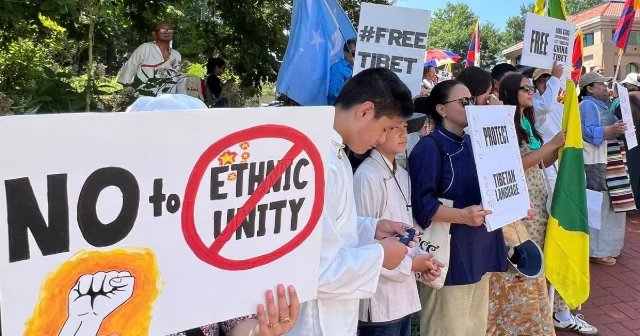
Tibet presents a similarly enduring dispute between state authority and cultural identity.
Tibetan activists and advocacy groups continue to raise concerns over restrictions on religious practice, cultural expression and political freedom. The disappearance of the Panchen Lama after his recognition by the Dalai Lama in 1995 remains a powerful symbol of the confrontation between Tibetan religious institutions and Chinese state authority. China’s Human Rights Crisis Has…
The reach of China’s security apparatus has also become an international concern. Human rights advocates have alleged that Chinese authorities monitor, pressure or intimidate dissidents and diaspora communities outside China. If such activities are substantiated, they raise questions extending beyond individual rights: they touch on the sovereignty of countries where those communities live and the ability of democratic societies to protect political refugees, journalists and activists from foreign coercion. China’s Human Rights Crisis Has…
These issues cannot be separated entirely from the wider question of China’s international conduct.
Taiwan is the clearest example. Rising tensions across the Taiwan Strait have made deterrence and diplomacy central concerns for governments throughout the Indo-Pacific. Any conflict would have consequences far beyond the island itself, affecting regional security, global trade and international stability.
Yet the answer to those strategic risks cannot be to place human rights permanently on the diplomatic back burner.
There is a recurring danger in international politics: once a country becomes too economically or strategically important, governments begin treating difficult questions about its domestic conduct as inconvenient rather than essential. That approach may produce short-term diplomatic convenience, but it weakens the credibility of the principles that democratic governments claim to defend.
Human rights should not be raised only when relations are good, nor abandoned when relations become difficult.
The same principle applies to China. Engagement with Beijing is necessary. Dialogue on trade, climate, technology, regional security and arms control remains important. But engagement is strongest when governments can pursue cooperation without surrendering the ability to speak plainly about fundamental freedoms.
China’s global influence will continue to grow, and its decisions will increasingly shape international politics. That makes the treatment of its citizens and communities more—not less—relevant to the international debate.
The cases of imprisoned dissidents, restricted religious communities, Uyghurs, Tibetans and Hong Kong’s pro-democracy activists represent different circumstances and should not be reduced to a single narrative. But together they point to a broader question about the limits of political and civil freedom under China’s current system.
The international community does not have to choose between dealing with China and defending human rights. It can do both.
The real test is whether governments are willing to maintain that position when strategic interests make doing so uncomfortable. If human rights disappear from the conversation whenever trade or security takes priority, then the principle becomes conditional.
China’s human rights crisis has not disappeared. The world’s attention has simply moved elsewhere. The responsibility of international diplomacy is to ensure that it does not remain there.