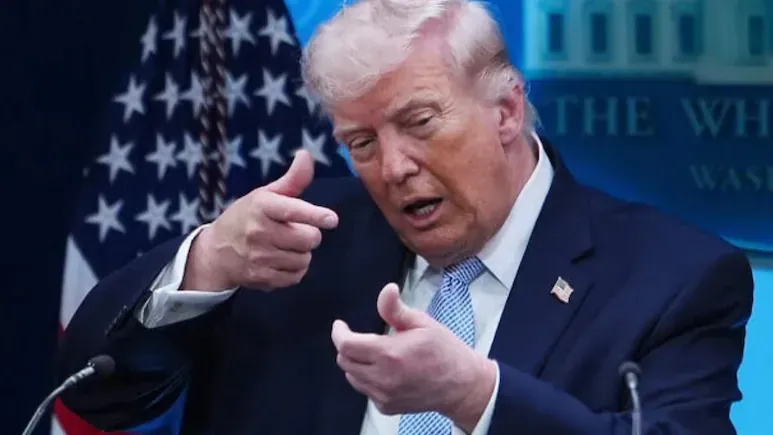
US President Donald Trump has said Washington is holding discussions with Russia and China on nuclear disarmament, raising the prospect of a broader arms-control effort involving the world’s three largest nuclear powers. However, he has provided no details on the scope of the talks, their progress or whether they could lead to a formal agreement.
Speaking in an interview with Newsmax on Thursday, Trump said he had discussed denuclearisation with Russian President Vladimir Putin and Chinese President Xi Jinping. He described the spread of nuclear weapons as a serious concern and said he would like to reduce the global threat posed by them.
“The whole thing is a shame, because I'd love to denuclearise if possible,” Trump said, adding that the United States was talking to both Moscow and Beijing about the issue.
Trump also argued that China’s nuclear arsenal was expanding rapidly and could catch up with that of the United States within five or six years. He suggested that Beijing might be less inclined to pursue disarmament because its arsenal remains smaller than those of Washington and Moscow.
Neither the White House nor the Russian and Chinese governments had publicly outlined a negotiating framework or announced concrete commitments linked to the discussions.
A widening gap in nuclear arms control
Trump’s remarks come at a consequential moment for international arms control. The New Strategic Arms Reduction Treaty, known as New START, expired earlier in 2026, removing the last major bilateral agreement placing limits on the deployed strategic nuclear forces of the United States and Russia.
Signed in 2010, the treaty imposed limits on deployed strategic warheads and delivery systems and established verification arrangements intended to improve transparency between the two countries. It was extended once, for five years, by then-US President Joe Biden and Putin in 2021. Any new arrangement would require fresh political agreement.
The treaty’s expiration has heightened concerns that the two countries could face fewer formal constraints on their strategic nuclear arsenals. Washington and Moscow together possess the overwhelming majority of the world’s nuclear weapons, making their relationship central to any effort to limit the risks of a nuclear arms race.
Bringing China into a wider framework would add another layer of complexity. Beijing has historically resisted joining arms-control negotiations structured around the much larger US and Russian arsenals, arguing that the three countries do not possess equivalent nuclear capabilities.
China’s expanding arsenal
China has been modernising and expanding its nuclear forces, adding urgency to discussions about whether existing arms-control arrangements can accommodate a changing strategic balance.
The Stockholm International Peace Research Institute estimates that China possessed around 620 nuclear warheads in January 2026, substantially fewer than the arsenals held by the United States and Russia. Both Washington and Moscow have thousands of warheads in their overall stockpiles, although totals differ depending on whether retired weapons awaiting dismantlement are included.
Trump’s prediction that China could catch up with the United States within five or six years was not accompanied by a detailed assessment or supporting projections. The pace of China’s nuclear expansion, the future size of its arsenal and Beijing’s willingness to enter formal negotiations remain important uncertainties.
For China, any agreement would also involve questions about transparency, verification and the balance between maintaining a credible deterrent and limiting strategic competition. Beijing has traditionally maintained that its nuclear posture is defensive and has called on the largest nuclear powers to take the lead in disarmament.
The challenge of a three-power agreement
A nuclear agreement involving the United States, Russia and China would be considerably more difficult to negotiate than a bilateral treaty. The three countries have different force structures, strategic priorities and approaches to deterrence.
A workable arrangement would need to address not only warhead numbers but also the systems used to deliver nuclear weapons, the treatment of reserve and non-deployed warheads, verification mechanisms and compliance procedures. The countries would also need to determine whether limits should apply equally or reflect differences in their existing arsenals.
The geopolitical environment adds further complications. Relations between Washington and Moscow remain strained by Russia’s war in Ukraine, while US-China competition extends across military technology, regional security and economic policy. These disputes could make sustained cooperation difficult even if all three governments agree that uncontrolled nuclear competition carries risks.
Trump’s comments signal an expressed interest in pursuing dialogue, but they do not establish that negotiations have reached an advanced stage. No proposed limits, timetable or verification arrangements have been made public.
The immediate question is whether the reported conversations can develop into a structured diplomatic process. With New START no longer in force, the absence of a replacement leaves Washington and Moscow without the treaty’s previous constraints and verification framework, while China’s growing arsenal complicates the search for a new model.
A three-power agreement could reshape the future of nuclear arms control. For now, however, Trump’s remarks indicate an ambition rather than a negotiated outcome.