When an army chief in Rawalpindi shuffles his deck, the appointments are never purely operational. In Pakistan, three-star promotions function as institutional referendums: they reward regime preservation, settle internal factional rivalries, consolidate expanding economic stakes, and preempt succession headaches.
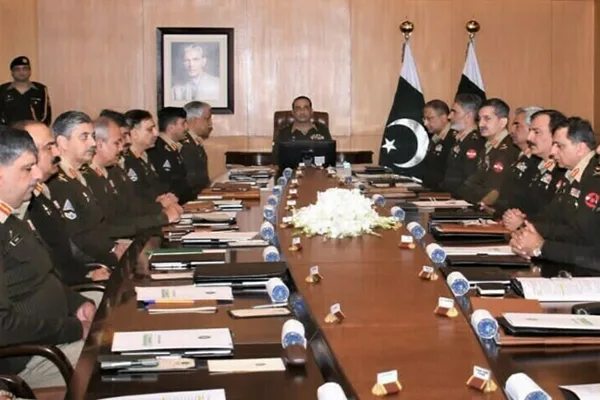
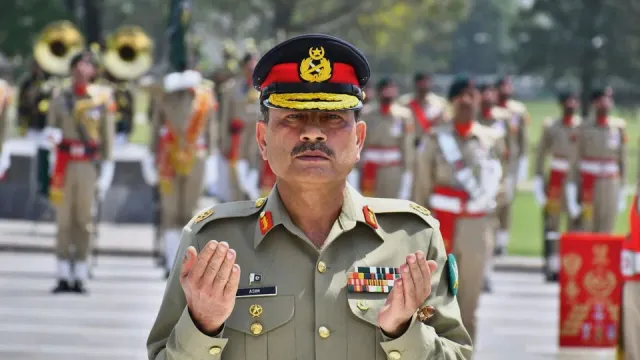
The latest elevation of Major Generals to Lieutenant General dominated by the 86th Pakistan Military Academy (PMA) Long Course alongside select 87th Course officers serve a distinct purpose. Chief of Army Staff (COAS) General Asim Munir is assembling a tightly disciplined, frictionless Praetorian guard.
By largely bypassing the 85th Long Course, Munir is methodically staffing General Headquarters (GHQ) and sensitive field commands with officers whose loyalties are tied directly to his own tenure.
The Anatomy of the 86th Long Course Sweep
The decision to supersede the bulk of the 85th Long Course reflects standard Rawalpindi statecraft accelerated under intense political friction. Pulling up officers who owe their career peaks to the current chief neutralizes potential rival power centers before they can coalesce.
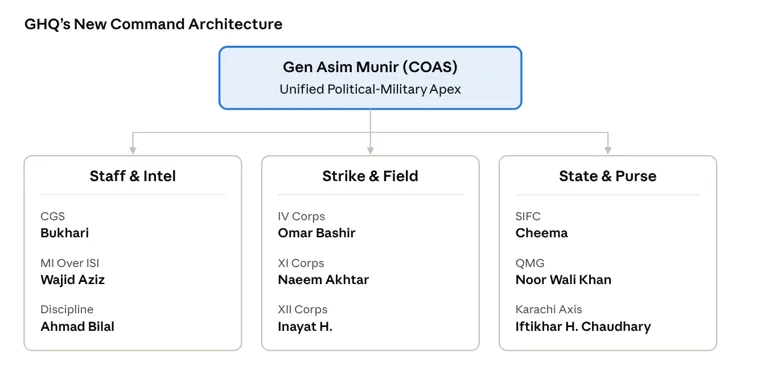
This promotional slate reveals four main institutional priorities:
Rewarding the Internal Purge
The fallout from May 9 when civilian demonstrators breached GHQ gates and ransacked the Corps Commander House in Lahore provoked an aggressive internal purge.
Lt Gen Ahmad Bilal (ex-DG Personnel Services & Provost Marshal): Bilal's promotion directly reflects his role overseeing disciplinary measures and the court-martials of more than 800 military personnel. Elevating the officer who wielded the administrative hammer serves as a pointed reminder to the ranks: internal dissent carries an immediate price.
Lt Gen Wajid Aziz (ex-DG Military Intelligence): In the institutional tug-of-war between Military Intelligence (MI) and Inter-Services Intelligence (ISI), Aziz’s promotion paired with the transfer of ISI counter-intelligence officer Maj Gen Faisal Naseer to NACTA reaffirms the primacy of the army chief's direct intelligence line. GHQ reports directly through the COAS Secretariat, bypassing autonomous intelligence fiefdoms.
Entrenching the Military-Led Economy
Under Munir, economic policy has increasingly converged with the military apparatus via the Special Investment Facilitation Council (SIFC).
Lt Gen Asad-ur-Rehman Afzal Cheema: Promoting the head of the SIFC to three-star rank cements the civil-military economic hybrid. State asset privatizations, foreign direct investment, and sovereign negotiations are now firmly handled by uniformed personnel.
Lt Gen Noor Wali Khan (Quartermaster General): Moving from the Ministry of Interior into the Quartermaster General’s seat places Khan at the helm of the army’s commercial assets, procurement channels, and real estate interests.
Lt Gen Iftikhar Hassan Chaudhary: Promoted after serving as DG Rangers (Sindh), Chaudhary's elevation highlights GHQ’s dependence on paramilitary administrative enforcement to control Karachi's civic apparatus and commercial infrastructure.
Command Shifts: Locking Down the Center and Periphery
Lt Gen Omar Ahmed Bukhari Chief of General Staff (CGS): Effectively the operational second-in-command; directs Military Operations (MO) and MI to align border posture with domestic stability operations.
Lt Gen Muhammad Omar Bashir Corps Commander IV Corps (Lahore): Brought in to maintain strict administrative control over Punjab's political base and suppress civilian political demonstrations.
Lt Gen Amer Nawaz Corps Commander X Corps (Rawalpindi): Retained in position; secures the twin cities, GHQ, and the Prime Minister’s Secretariat against institutional shocks.
Lt Gen Muhammad Naeem Akhtar Corps Commander XI Corps (Peshawar): Tasked with adopting a measured, local posture to handle cross-border TTP militancy and persistent tribal unrest across Khyber Pakhtunkhwa.
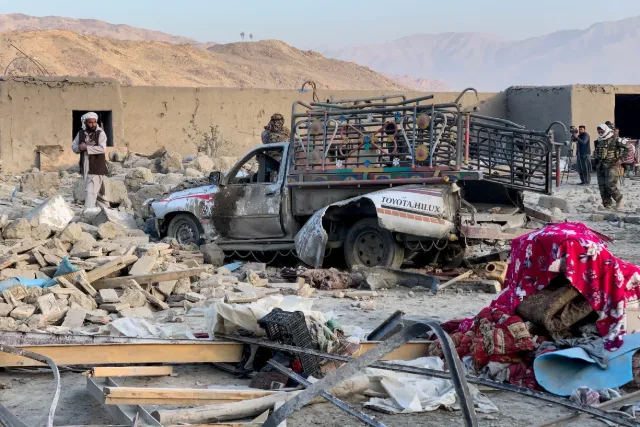
Lt Gen Inayat Hussain Corps Commander XII Corps (Quetta): Sent to Quetta to address escalating Baloch insurgent activity, secure CPEC routes, and tighten control over provincial finances.
Lt Gen Shakir Ullah Khattak Corps Commander I Corps (Mangla): Returns from industrial oversight at Taxila to take charge of a key offensive strike formation on the eastern border.
Institutional Durability
These postings show an army chief shifting from reactive crisis response to deep administrative consolidation.
By securing Lt Gen Omar Bukhari as Chief of General Staff and retaining Lt Gen Amer Nawaz at X Corps in Rawalpindi, Munir controls both the capital’s perimeter and the army's central operations hub. Assigning Lt Gen Omar Bashir to IV Corps in Lahore sets an uncompromising barrier against political unrest in Punjab. At the same time, regional balancing through officers like Lt Gen Muhammad Ishaq Khattak (ex-SPD) preserves Pashtun and Frontier Force representation across senior desks without compromising loyalty.
The rise of the 86th Long Course makes it clear that GHQ is positioning itself for an extended run at direct state management. The hybrid regime has evolved past a stopgap arrangement; with serving officers steering strategic investments, municipal security, domestic intelligence, and regional diplomacy, the current military setup has become the operating framework of the state itself.