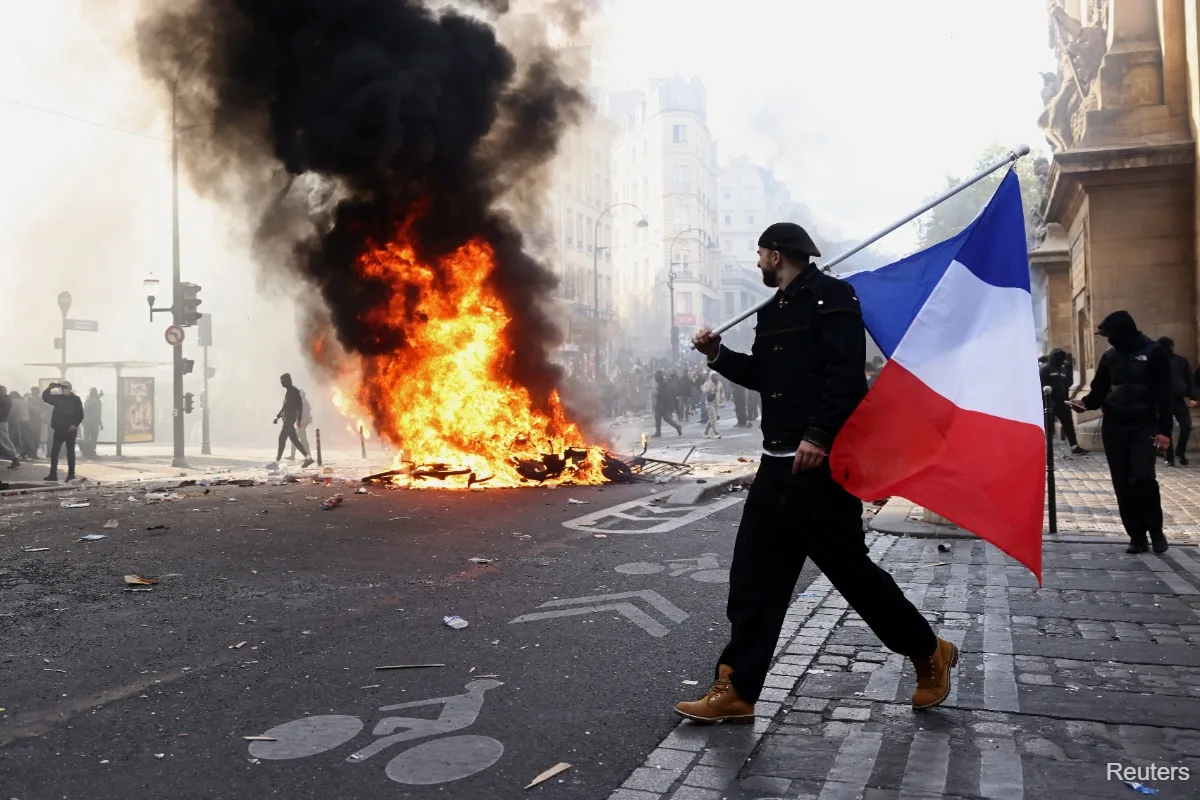
France is confronting a crisis that extends far beyond the streets. The protests, school blockades and violent clashes spreading across the country have exposed a widening gap between what French citizens expect from their state and what its political system can realistically deliver.
The immediate grievances are tangible. Students have protested against inadequate school facilities, teacher shortages and declining educational conditions. Workers are resisting proposed budget cuts and pressure on public-sector pay. Households are struggling with the cost of living, while growing numbers of citizens question whether successive governments can improve their prospects.
These grievances have converged at a moment when President Emmanuel Macron’s administration is struggling to impose fiscal discipline on a fragmented political system. The government argues that spending restraint is necessary to bring France’s public finances under control. Protesters fear that the cost of adjustment will fall on public services and ordinary households already under pressure.
Neither concern can simply be dismissed. France cannot indefinitely finance commitments that its revenues cannot sustain. But austerity imposed without a credible account of who will bear the burden risks deepening the very social divisions that make reform difficult.
The crisis is therefore not merely about whether France should spend more or less. It is about whether the country can establish a new social compact in which public money is used effectively, sacrifices are distributed fairly and citizens believe that reform offers a future worth accepting.
A Welfare State Under Financial Pressure
France built one of the most extensive welfare systems in Europe. Public healthcare, pensions, social protection and state-funded education have long been central to the country’s social model. They reflect a political settlement in which the state assumes broad responsibility for cushioning citizens against economic insecurity.
That settlement remains important. It also comes with a substantial financial obligation.
France’s public debt has risen to levels that leave the government increasingly exposed to borrowing costs, while its budget deficit remains well above the European Union’s reference limit. Servicing accumulated debt reduces the room available for new priorities, and investors are becoming more sensitive to the country’s political and fiscal uncertainty.
The government’s proposed spending reductions are an attempt to address this imbalance. Yet the political difficulty is obvious: nearly every major constituency has a reason to resist measures that might reduce its benefits, income or access to services.
Pensioners oppose changes that threaten retirement security. Public-sector workers resist wage restraint and staffing reductions. Students demand better schools and more reliable educational opportunities. Local communities fear that cuts will weaken already overstretched services.
Each concern has a legitimate constituency. The difficulty is that their combined demands cannot be evaluated independently of the state’s financial capacity.
This is the central contradiction confronting France. Citizens expect the government to preserve the protections they value, repair deteriorating services and respond to new social needs. At the same time, political resistance makes it difficult to agree on the taxes, spending reductions or structural changes required to finance those commitments.
The result is a cycle in which governments announce reforms, opponents mobilise, concessions dilute the original plans and the underlying fiscal pressures remain unresolved.
A country cannot escape that cycle through slogans about protecting the welfare state or restoring budget discipline. It needs a credible agreement about what the state can afford, what it must protect and how the costs of adjustment should be shared.
The Crisis Begins in the Classroom
The role of students in the current unrest is particularly significant.
The protests began with complaints about school conditions, including shortages of teachers, inadequate facilities and concerns about educational quality. Those demands might appear narrow compared with France’s broader economic problems. In reality, they touch one of the most important responsibilities of the modern state: preparing the next generation for economic and social participation.
Education is central to the promise of equal opportunity. A young person’s prospects should not depend overwhelmingly on family wealth, neighbourhood or access to private resources. When public schools struggle to provide adequate teaching and facilities, that promise becomes harder to sustain.
For students, the issue is not only the condition of a classroom. It is whether education will provide a credible route to employment, independence and a better standard of living.
That anxiety is sharpened by a wider sense of economic uncertainty. Young people are being asked to accept fiscal restraint while confronting doubts about their future opportunities. If they believe that established institutions protect existing interests more effectively than they create new possibilities, frustration can quickly become political alienation.
The danger for the government is that treating the protests primarily as a public-order problem will fail to address their underlying causes. Policing may be necessary when demonstrations turn violent, but it cannot recruit missing teachers, repair unsafe facilities or restore confidence in educational opportunity.
The opposite mistake would be to assume that every demand can be met through additional spending. More money does not automatically produce better outcomes if staffing, administration and resource allocation remain ineffective.
France needs an education strategy that combines adequate funding with measurable improvements in teaching, school conditions and student outcomes. Young people need evidence that the state is responding to their concerns rather than simply managing the political consequences of their anger.
Macron’s Problem Is Political as Much as Economic
Macron entered office in 2017 promising to overcome France’s traditional political divisions and modernise its economy. His programme included labour-market reform, investment in economic competitiveness and an effort to reposition France within Europe.
His presidency has produced changes in economic policy and maintained France’s role as an important European diplomatic and security power. But his reform agenda has also generated sustained opposition, particularly when changes to pensions, employment and public spending have been perceived as unfairly distributed.
The political crisis has become more difficult since the 2024 snap parliamentary election left France with a fragmented legislature and no stable majority capable of governing without negotiation. That fragmentation has constrained the government’s ability to build a durable consensus on spending and reform.
The current unrest has intensified those weaknesses. A government that lacks a secure parliamentary foundation has fewer options for negotiating painful adjustments. Every proposed measure becomes a potential test of its survival, while every concession risks weakening its ability to demonstrate fiscal credibility.
Macron’s remaining time in office is also limited by the approaching end of his presidential term. The question is no longer simply whether he can advance his programme, but whether the political system can agree on a sustainable direction beyond his presidency.
This is a broader institutional problem. France’s difficulties cannot be reduced to the personality or decisions of one president. Yet leadership matters when a country must persuade competing groups to accept trade-offs.
A credible response requires more than defending a budget or condemning disorder. It requires political leaders to explain the choices facing the country, acknowledge the failures that have fuelled public anger and demonstrate that the burdens of reform will not fall disproportionately on those with the least capacity to absorb them.
Without that effort, even technically sound policies will struggle to command public consent.
Protest Is a Democratic Signal, Not a Governing Programme
France has a long tradition of street demonstrations, strikes and mass mobilisation. Public protest has helped shape its labour protections, social rights and political institutions. The right to demonstrate remains an essential part of democratic life.
But the current crisis also illustrates the limits of protest as a substitute for governing.
The demands emerging from the streets are not always mutually compatible. Citizens want better services, secure employment and stronger social protections, while many also resist the taxes or spending reductions that might be required to sustain them. Different groups may agree that the existing system is failing without agreeing on what should replace it.
Violence and attacks on public buildings or businesses further complicate the situation. They can undermine support for legitimate grievances, impose costs on local communities and give authorities a reason to focus on security rather than policy.
The government, for its part, cannot claim that restoring order alone will resolve the crisis. A return to normal streets would not necessarily mean that public confidence had been restored.
The essential task is to translate social discontent into decisions that can be debated, financed and implemented. That requires political parties to present credible programmes rather than promise that all existing benefits can be protected without difficult choices.
It also requires institutions to demonstrate that participation matters. If citizens repeatedly conclude that their concerns are heard only when demonstrations become disruptive, political alienation may deepen rather than recede.
The Far Right and Far Left Are Benefiting From the Vacuum
France’s political fragmentation creates opportunities for parties that portray the established system as incapable of delivering meaningful change.
Marine Le Pen’s National Rally has built support through its emphasis on immigration, public order, national sovereignty and opposition to the political establishment. On the left, Jean-Luc Mélenchon and France Unbowed have presented a contrasting programme focused on redistribution, social protection and a fundamental reorientation of political power.
Their approaches differ sharply, but both draw on dissatisfaction with the existing political order. The current unrest gives them additional opportunities to argue that established parties have failed.
That does not mean the protests belong to either political camp, or that public anger will automatically translate into electoral support for one of them. The demonstrators include people with different concerns and political priorities. Their immediate demands cannot be reduced to a single ideological programme.
Nevertheless, when mainstream institutions struggle to offer credible solutions, parties promising a decisive break with the status quo can gain attention.
The risk is that political competition becomes a contest between incompatible promises rather than a serious discussion of the country’s constraints. A programme that promises to expand public commitments without explaining how they will be financed faces one set of problems. A programme that promises to restore order without addressing failing services faces another.
France needs political alternatives that confront both its social obligations and its financial limits. The country’s problems will not disappear simply because a different party occupies the Élysée Palace.
France’s Crisis Is Europe’s Problem Too
France’s domestic difficulties have consequences beyond its borders.
Together with Germany, France has traditionally served as a central driver of European integration. Its diplomatic influence, nuclear deterrent, military capabilities and permanent seat on the United Nations Security Council give it a role that extends well beyond its economic weight alone.
A prolonged period of political paralysis in Paris would complicate Europe’s response to several strategic challenges: Russia’s war against Ukraine, competition with China, uncertainty in transatlantic relations and the need to strengthen European defence capabilities.
Fiscal weakness also limits France’s ability to invest in infrastructure, technology and military readiness while meeting existing social commitments. Higher borrowing costs can narrow those choices further.
Europe therefore has a direct interest in France restoring both economic credibility and political stability. But that does not mean France should abandon its social model to satisfy financial markets, nor that European fiscal rules alone can resolve the country’s internal divisions.
The challenge is to make the French state more effective and financially sustainable while preserving the public goods that underpin social cohesion.
That requires stronger productivity, more efficient public administration, investment in education and skills, and a transparent debate about taxation and spending. It also requires European partners to recognise that the sustainability of the eurozone depends partly on the capacity of its largest economies to manage political and fiscal pressures without prolonged instability.
A New Social Compact Is the Missing Piece
France does not lack resources, expertise or institutional experience. Its economy remains substantial, its scientific and industrial capabilities are significant, and its public institutions retain considerable capacity. The problem is that these strengths have not been sufficient to reconcile the country’s social expectations with its financial and political constraints.
A durable response must begin with a straightforward principle: reform will be sustainable only if citizens believe that it is necessary, effective and fair.
That means identifying which public services require urgent investment, where spending can be made more efficient and which existing commitments can be adjusted without placing excessive pressure on vulnerable households. It means explaining the costs of policy choices honestly, rather than promising benefits without acknowledging the trade-offs.
It also means confronting privilege and unequal access to opportunity. If citizens see public resources being protected for influential groups while schools deteriorate and essential services weaken, appeals for sacrifice will lack credibility.
No single budget can repair that loss of trust. It requires sustained political negotiation, transparent decision-making and measurable improvements in the services people use.
France’s leaders must also recognise that fiscal discipline and social protection are not necessarily opposing objectives. Uncontrolled debt can ultimately undermine the state’s ability to fund public services. But indiscriminate cuts can weaken the social foundations that make economic adjustment politically possible.
The task is to distinguish between spending that sustains long-term prosperity and spending that cannot be justified by its outcomes, while ensuring that the costs of change are not concentrated on those least able to bear them.
The Real Test for France
France is burning because its institutions are struggling to manage a collision between expectations, resources and political consent. The protests have made that collision visible, but they did not create it.
The country cannot preserve every existing commitment unchanged, finance new demands indefinitely through borrowing and expect public services to improve automatically. Nor can it restore fiscal credibility by ignoring the conditions that have driven students and workers into the streets.
The immediate challenge is to contain violence, protect public safety and reopen meaningful channels for negotiation. The larger challenge is to rebuild confidence in a state that remains ambitious in its promises but increasingly constrained in its capacity to deliver.
That will require political leaders to move beyond the familiar choice between austerity and unlimited spending. France needs a new agreement about the responsibilities of government, the obligations of citizens and the distribution of sacrifice in a period of tighter resources.
The country’s future will not be secured by restoring order alone, replacing one political leader with another or announcing another package of reforms. It will depend on whether France can make its institutions responsive, its public finances sustainable and its social contract credible to a generation that is questioning whether the existing model still works.
The protests are a warning. The deeper danger is that France’s political system will treat them as another episode to survive rather than a demand to change how the country governs itself.