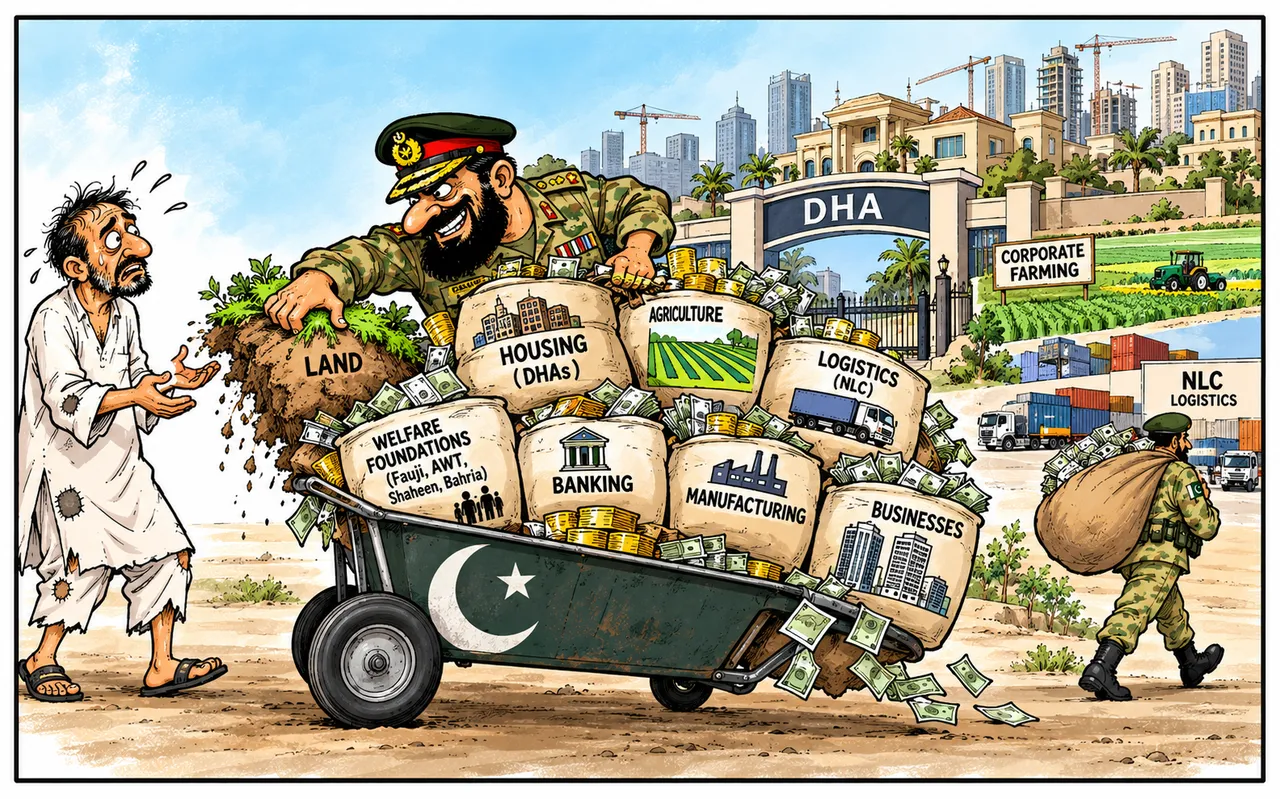
Pakistan’s military has developed an extensive economic network that reaches well beyond its conventional defence responsibilities, with military-linked institutions involved in real estate, agriculture, logistics, banking, manufacturing and other commercial activities. The system has evolved over decades through land allocations, welfare foundations, housing authorities and state-linked enterprises, giving the armed forces an economic presence that remains difficult to measure fully from public records.
The roots of this structure stretch back to the colonial period, when large areas of Punjab were brought under irrigation and agricultural development and land was distributed to soldiers and officers according to rank. After Pakistan’s independence in 1947, many of the administrative arrangements governing cantonments, military land and related benefits remained in place.
The system subsequently expanded as the military established or gained influence over organisations operating in civilian economic sectors. In her study of Pakistan’s military economy, scholar Ayesha Siddiqa described this phenomenon as “Milbus”, referring to military-controlled capital and commercial activity associated with serving and retired officers.
Land remains one of the most visible forms of military privilege. In January 2017, Pakistan’s military media wing confirmed that former army chief General Raheel Sharif had been allotted 90 acres of land near Lahore following his retirement. The military said the allocation followed established constitutional and administrative procedures and that similar arrangements applied to army chiefs.
The case illustrates how military service, particularly at senior ranks, can be linked to access to valuable land. The process of allocating such property has periodically generated public debate over eligibility, transparency and the extent to which civilian authorities exercise meaningful oversight.
Real estate has become an important part of the military’s wider commercial footprint. Defence Housing Authorities operate in major cities including Lahore, Karachi, Islamabad, Rawalpindi, Multan, Gujranwala and Quetta. Their housing projects have transformed large areas of land into residential and commercial developments, while providing housing and investment opportunities to military personnel and civilians.
The military’s role in agriculture has also grown. Under the Green Pakistan Initiative, the armed forces have taken a central role in plans for large-scale corporate farming on state-owned land. The initiative has been described as potentially covering up to 4.8 million acres in Punjab and Sindh.
More than 52,000 acres in Sindh were earmarked for military-linked corporate entities under long-term leases, while land transfers in Punjab became the subject of legal proceedings. The military has defended its involvement by linking agricultural development to national food security.
The expansion has revived an older dispute over military use of agricultural land. In Okara, tenant families cultivated roughly 17,000 acres of government land for generations under crop-sharing arrangements. Attempts around 2000 to replace those arrangements with short-term cash leases triggered resistance, arrests and blockades. The army later acknowledged before the National Commission for Human Rights that the land belonged to the Punjab government and was being used to produce fodder.
Beyond property and agriculture, military-linked welfare organisations have become significant business operators. The Fauji Foundation, established in 1954, has interests in industries including fertiliser, cement, energy and banking. The Army Welfare Trust, Shaheen Foundation and Bahria Foundation are also associated with commercial operations.
These organisations generally justify their businesses through their welfare missions. The Fauji Foundation, for example, says its commercial activities generate funds for veterans, serving personnel and the families of soldiers. The structure has nevertheless prompted questions about the level of financial disclosure available to the public compared with the requirements imposed on conventional listed companies.
The National Logistics Corporation provides another example of the military’s long-term economic reach. Established in 1978 to deal with a port crisis in Karachi, it continued operating after the original emergency and developed into a major freight, construction and logistics organisation. A parliamentary committee later recommended transferring military freight operations back to Pakistan Railways, but the recommendation did not lead to a significant change.
The economic influence associated with the military has also extended into the careers of individual officers. Retired senior commanders have subsequently occupied positions in government ministries, state enterprises, regulatory institutions and other public bodies. While individual appointments may be officially announced, the absence of a comprehensive public record makes it difficult to assess the overall scale of former military personnel occupying civilian positions.
The wealth of senior officers and their families has periodically generated further scrutiny. Investigative reports concerning the family assets of former army chief General Qamar Javed Bajwa and business interests associated with relatives of Lieutenant General Asim Saleem Bajwa have raised questions about the relationship between military careers, family wealth and access to commercial opportunities.
Those reports have also been disputed. Bajwa’s family asset reporting was described by the military as misleading, while Asim Saleem Bajwa denied allegations of wrongdoing and offered to provide financial records. The claims have not all been tested through judicial proceedings and therefore remain distinct from established findings of misconduct.
The broader issue is the limited visibility surrounding a system that combines military authority with extensive commercial activity. Land allocations, housing schemes, welfare foundations, agricultural projects and logistics operations may each have formal legal or administrative foundations, but the availability of comprehensive independent information varies considerably.
For supporters, the military’s commercial institutions provide a mechanism for funding welfare programmes and supporting veterans and their families without placing the entire burden on the state budget. Critics, however, have questioned whether the scale of the military’s economic presence creates advantages that are difficult for ordinary businesses and citizens to challenge.
The debate ultimately centres on transparency rather than the existence of military welfare institutions alone. Comprehensive records of military landholdings, clear rules for land allocations, independently audited accounts and greater disclosure of post-retirement appointments would provide a clearer picture of how the system operates.
Pakistan’s military economy has consequently become more than a collection of individual companies or welfare schemes. It is an institutional network connecting land, housing, agriculture, logistics, industry and senior military careers. Its development over decades has made the armed forces an important economic actor in Pakistan, while the absence of complete public disclosure continues to leave questions about the full extent of that influence.