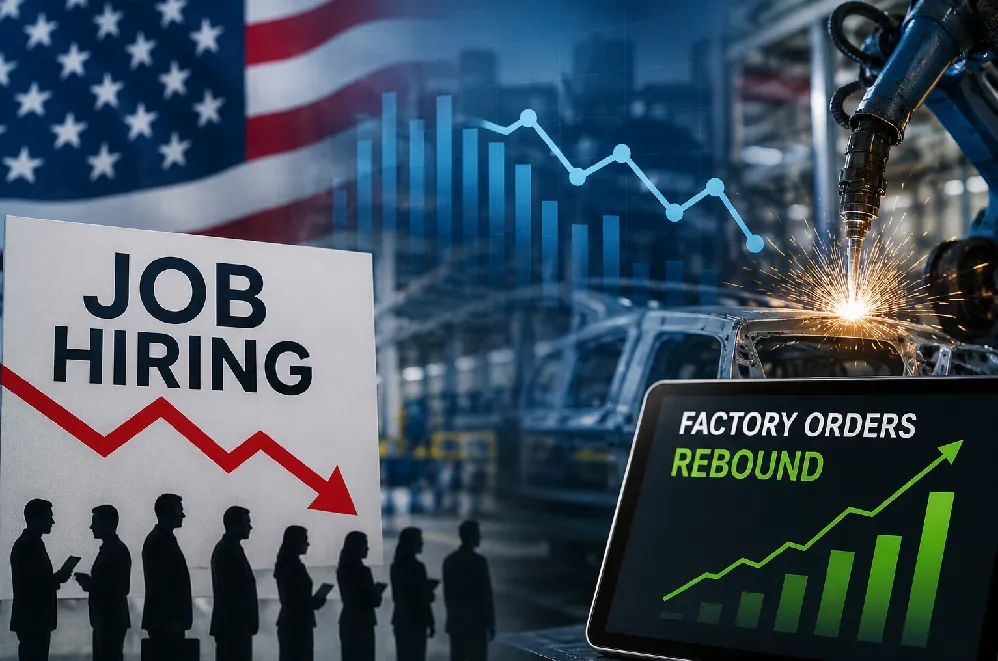
WASHINGTON — US private employers added fewer jobs than expected in August, pointing to a cooling labour market even as a separate report showed factory orders recovering in July on stronger demand for aircraft.
Private payrolls increased by 38,000 last month, down from a revised 46,000 gain in July, according to the ADP National Employment Report released on Wednesday. Economists surveyed by Reuters had expected an increase of 48,000 jobs.
The figures suggest that the US labour market remains subdued after a brief improvement earlier in the year. Economists have described current conditions as a “slow-hire, slow-fire” environment, with businesses adding workers cautiously while layoffs remain relatively limited.
Education and health services provided the biggest source of new employment in August, adding 45,000 jobs. Leisure and hospitality companies added 16,000, construction payrolls increased by 12,000 and financial activities gained 6,000 positions.
Those gains were partly offset by losses in other industries. Manufacturing employment fell by 17,000, while professional and business services shed 16,000 jobs. Trade, transportation and utilities, information, and natural resources and mining also recorded declines.
The ADP figures come two days before the US Labor Department is due to release its broader employment report for August. The government data cover both private and public employment and are generally regarded as a more comprehensive measure of labour-market conditions. ADP’s figures have not always been a reliable predictor of the official monthly payroll estimate.
The latest data also come as policymakers and investors assess the effects of President Donald Trump’s trade and immigration policies. Economists have pointed to uncertainty created by import tariffs and changes to immigration rules as factors that could restrain hiring.
There is little evidence so far that the rapid adoption of artificial intelligence is the main cause of weaker employment growth, economists said. Bill Adams, chief economist at Fifth Third Commercial Bank, said policy changes affecting immigration were likely to have had a greater impact on August hiring than AI.
The labour market’s cooling has increased attention on the Federal Reserve’s interest-rate decisions. The unemployment rate was expected to remain at 4.1 per cent in August, according to economists surveyed by Reuters, with the official jobs report likely to provide a clearer indication of whether the slowdown is becoming more pronounced.
In a separate report, the Commerce Department said US factory orders rose 0.9 per cent in July after falling by a revised 0.2 per cent in June. Orders were up 6.5 per cent from a year earlier and exceeded the 0.6 per cent increase economists had forecast.
The increase was driven largely by a sharp recovery in demand for civilian aircraft and parts. Aircraft orders jumped 12.7 per cent in July. Orders for machinery rose 0.8 per cent, while motor vehicle bodies, parts and trailers increased 0.4 per cent.
Not all manufacturing categories strengthened. Orders for computers and electronic products fell 1.1 per cent during the month, although they remained 14.3 per cent higher than a year earlier. Orders for electrical equipment, appliances and components declined 0.3 per cent.
A measure of planned business investment was less encouraging. Orders for non-defence capital goods excluding aircraft, closely watched as an indicator of future equipment spending, were unchanged in July. The figure was previously estimated to have increased 0.2 per cent.
Shipments of those core capital goods rose 1.2 per cent, below the initial estimate of 1.4 per cent.
Economists nevertheless expect the weakness in core capital-goods orders to prove temporary. Government data showed a sharp increase in capital-goods imports in July, while heavy investment in artificial-intelligence infrastructure continues to support demand for equipment.
Manufacturers are meanwhile dealing with higher input costs and supply-chain pressures. An Institute for Supply Management survey released on Tuesday showed businesses reporting increased prices linked to tariffs and disruptions associated with the conflict involving the United States and Israel and Iran.
Taken together, the reports point to an economy in which employment growth is losing momentum while business investment and manufacturing demand remain uneven. The official employment figures due Friday will provide the next and more closely watched test of the US labour market.