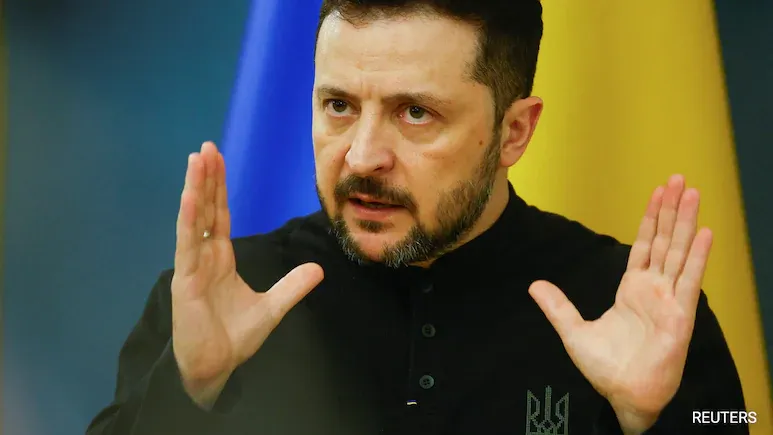
Ukrainian President Volodymyr Zelenskyy has ordered the resumption of attacks on Russian oil refineries after accusing Moscow of ignoring a proposed energy ceasefire announced by US President Donald Trump. The decision has intensified tensions between Kyiv and Washington as efforts to halt the war remain stalled.
Ukraine struck a Rosneft-owned refinery in Russia’s Ryazan region on October 15, setting the facility on fire, according to Russian regional authorities. A senior Ukrainian official confirmed that Kyiv had carried out the attack. The refinery, located southeast of Moscow, accounts for nearly 5 per cent of Russia’s refining capacity and helps supply the capital.
The strike followed Zelenskyy’s declaration that Ukraine would no longer observe the pause it had accepted in attacks on Russian energy facilities. In an interview with the Financial Times, he said Kyiv had run out of patience after Russia continued launching missiles and drones against Ukrainian infrastructure.
“The block (on attacking refineries) is out. We’re done,” Zelenskyy said.
Trump had announced an energy ceasefire on October 11, claiming that Russia and Ukraine had agreed to stop attacks on energy infrastructure. Kyiv subsequently paused strikes against Russian refineries, but Moscow continued its aerial campaign against Ukrainian targets. Neither side had independently confirmed a comprehensive agreement on the terms described by Trump.
The breakdown has exposed the limitations of Washington’s attempt to secure a narrow truce without a broader settlement of the conflict. Russia and Ukraine continue to disagree over the scope of any ceasefire, while both sides seek to weaken the other’s ability to sustain military operations.
A ceasefire under strain
Ukraine’s decision followed renewed Russian attacks on energy facilities and other infrastructure. Ukrainian officials said Russian missiles and drones had struck targets across the country, disrupting electricity supplies and threatening civilian services as the war continued into its fifth year.
Kyiv argued that suspending attacks on Russian refineries while Russia continued targeting Ukrainian infrastructure would leave Ukraine at a disadvantage. Zelenskyy said the pause had been intended to demonstrate Kyiv’s willingness to negotiate, but Moscow’s continued strikes undermined that effort.
Russia, meanwhile, accused Ukraine of undermining the proposed truce. Foreign Minister Sergey Lavrov described Ukrainian attacks on Russian oil facilities as a direct challenge to Trump’s initiative. Russian officials have also disputed Kyiv’s account of the pause and its implementation, and the competing claims surrounding individual attacks have not all been independently verified.
The refinery campaign has become an important part of Ukraine’s effort to impose economic costs on Russia’s war machine. Strikes on oil-processing facilities can disrupt fuel production and distribution, although the extent of damage and the duration of any operational shutdown vary from site to site.
Trump has opposed the attacks, arguing that damage to Russian refineries contributes to higher global fuel prices. On October 16, he called Ukraine’s renewed strikes a “disgrace”, saying they were pushing up oil prices and affecting the availability of diesel fuel.
Tensions over US military support
The dispute extends beyond energy infrastructure. Zelenskyy has also complained that Ukraine recently faced restrictions on access to US intelligence concerning Russian missile attacks and on the use of US-made Starlink communications terminals.
Both capabilities are important to Ukraine’s battlefield operations, including the detection of incoming attacks and the coordination of forces. Any disruption can complicate military planning and increase pressure on Ukrainian air defences.
The communications dispute has also drawn Elon Musk into the growing confrontation. Ukraine relies heavily on Starlink connectivity, while the related Starshield system is controlled by the US government. The restrictions have raised concerns in Kyiv about the extent to which its military operations depend on systems and decisions outside Ukrainian control.
Zelenskyy’s criticism of Washington reflects a difficult calculation for Kyiv. Ukraine continues to depend on American military assistance and intelligence, yet its leadership fears that pressure to accept a limited ceasefire could constrain its ability to respond to Russian attacks.
The renewed refinery strikes risk worsening that disagreement. Trump has pressed Ukraine to stop attacks that he says damage global energy markets, while Kyiv argues that a ceasefire cannot function if Russia continues its own offensive operations.
A wider diplomatic impasse
The collapse of the energy pause highlights the gap between Washington’s efforts to secure an immediate reduction in hostilities and the conditions required to sustain one. A temporary halt to attacks on selected infrastructure cannot resolve the wider conflict unless both sides accept and observe its terms.
Ukraine’s latest actions also underline its strategy of targeting facilities that contribute to Russia’s military and economic resilience. Moscow has sought to downplay the impact of Ukrainian strikes, but refinery attacks remain a recurring pressure point in the conflict.
Ukraine’s military separately said it had damaged six Russian Su-34M military aircraft in an overnight strike on Borisoglebsk airfield in Russia’s Voronezh region, another indication that Kyiv intends to maintain pressure on Russian military assets.
For Trump, the dispute presents a challenge to his attempt to broker an energy truce and demonstrate progress towards ending the war. For Zelenskyy, the immediate priority remains securing protection against Russian attacks without surrendering Ukraine’s ability to strike back.
The resumption of refinery attacks does not, by itself, settle whether a broader ceasefire remains possible. It does, however, show that Washington’s announcement was not enough to secure a durable pause—and that Kyiv will not continue observing restrictions it believes Moscow has disregarded.