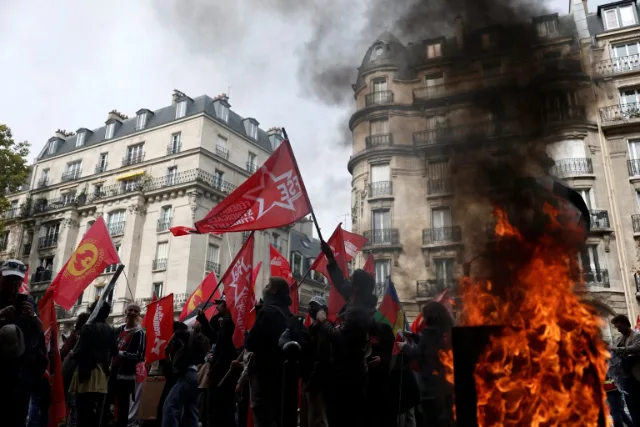
France witnessed widespread demonstrations on Saturday, October 17, as thousands of people took to the streets to protest rising living costs, economic inequality and deteriorating public services. The rallies, which brought together students, trade unionists and supporters of the Yellow Vest movement, were accompanied by clashes, arson and looting in several major cities.
Police used tear gas and water cannons to disperse violent groups in Paris, where cars, bicycles and rubbish bins were set alight near Place de la République. Shops were looted, public property was damaged and several people were injured. The Interior Ministry initially reported at least 272 arrests nationwide by mid-afternoon, with violent incidents also reported in Marseille, Lyon, Rennes, Toulouse and Angers.
Although most demonstrators participated peacefully, the violence highlighted the difficulty facing authorities as separate protest movements converge around shared economic grievances.
Student anger broadens into a national movement
The demonstrations developed from student protests that began in September, initially focusing on teacher shortages, deteriorating school facilities and inadequate educational resources. Students subsequently called on trade unions and other groups to join them, transforming the campaign into a broader expression of dissatisfaction with government policies.
The CGT, one of France’s largest trade unions, supported Saturday’s mobilisation, demanding higher wages and pensions, lower prices and stronger protection for public services.
The return of Yellow Vest activists has added further significance to the protests. The movement emerged in 2018 in opposition to fuel taxes before expanding into a wider challenge to economic inequality and the perceived burden of government policies on lower-income households.
Rising prices for petrol, energy and food have renewed those concerns. Many demonstrators argue that ordinary families are struggling to maintain their living standards while public services face mounting pressure.
Violence spreads beyond Paris
Paris was among the worst-affected cities, with masked demonstrators throwing fireworks and other objects at police. Officers responded with riot-control measures as fires spread through parts of the protest area.
In Lyon, a fire broke out inside a tourist office during demonstrations that attracted around 20,000 people. In Marseille, shops and a municipal police station were damaged, while protesters briefly entered the lobby of City Hall.
Authorities also reported attempts to loot businesses and attacks on public buildings elsewhere in the country. The incidents prompted police to restrict access to sensitive government areas and close several metro stations in Paris.
The violence has complicated efforts to distinguish peaceful demonstrators from groups involved in vandalism and clashes. Government officials have condemned the destruction, while the wider movement continues to demand action on living costs and public services.
Police conduct faces renewed scrutiny
The demonstrations have also revived concerns about the use of force against young protesters. Earlier clashes left several demonstrators seriously injured, prompting criticism of police tactics and renewed calls for accountability.
Interior Minister Laurent Nuñez suspended the use of a particular type of stun grenade during student protests after a 15-year-old suffered a severe hand injury. Authorities have faced questions over the circumstances of such incidents and the proportionality of riot-control measures.
Police maintain that officers must respond to attacks and protect public property. Critics, however, warn that aggressive responses risk worsening tensions and alienating students whose initial demands concerned education and public services.
Economic grievances pose a challenge for Macron
The unrest comes as President Emmanuel Macron’s government faces difficult choices over public spending, economic stability and social policy. Efforts to control France’s public deficit have constrained the scope for additional expenditure, even as protesters demand greater investment in education, improved wages and better services.
The demonstrations also carry political implications ahead of the next presidential election, scheduled for 2027. Opposition parties are seeking to capitalise on public dissatisfaction, while the government must address economic concerns without allowing further disorder to spread.
Saturday’s protests demonstrate that the grievances driving France’s unrest extend beyond any single policy. Whether the mobilisation becomes a sustained national movement will depend on the government’s response, the ability of unions and student groups to maintain cooperation, and whether peaceful demonstrations can continue without further violence.